

Summary
Pediatric occupational therapy does not use developmental milestones to determine how and if a child is using their skills in everyday life. OT helps with fine and gross motor skills, self-care, sensory regulation, school participation, feeding needs, play, and independent living. Professional evaluation might be beneficial when challenges are relentless, causing impacts such as safety, participation, confidence, or routines.
“My child can do it sometimes. So why are they still struggling?”
If you’ve asked yourself this, you’re not alone. It’s one of the most common things parents tell us: their child has a skill, but somehow can’t seem to use it when it actually counts.
Maybe your child can hold a pencil just fine, but writing for more than a few minutes wears them out. Maybe they know how to get dressed, but mornings are still a battle. Maybe they’ll eat a handful of foods happily, but the list never seems to grow. They might climb like a pro at the playground but seem all over the place with everyday coordination, or need constant reminders just to get through brushing their teeth.
You might think Why do kids need occupational therapy?
Occupational therapy isn’t simply a milestone checklist. It’s about function. About how your child truly participates and engages in the moments that make up their lives.
And you’re not surprised by this at all! According to CDC data from 2019, approximately 1 in 6 children aged between 3–17 years with one or more developmental disabilities have difficulty learning, moving about, communicating, playing, and behaving.
Helping kids to do the things that matter, more safely, comfortably, consistently, and independently along the way
What Does “Function” Mean in Pediatric Occupational Therapy?
In parent-friendly terms, function means how well a child can use their abilities in real life.
An OT may ask:
- Can your child participate in the activity?
- Can they do it safely?
- Can they do it consistently?
- How much help do they need?
- Does the difficulty interfere with home, school, play, or community activities?
Skill vs. Function
| Skill | Function |
|---|---|
| Can hold a fork | Can use a fork during meals |
| Can write letters | Can complete classroom writing tasks |
| Can put on shoes | Can get ready for school |
| Can tolerate one texture | Can participate in routines involving different textures |
| Can climb | Can coordinate movement during play and daily activities |
Developmental milestones are useful tools for monitoring development. The CDC’s milestone checklists focus on skills that 75% or more of children are expected to demonstrate by a given age.
But a milestone is not a complete picture of a child’s daily life. Missing one milestone does not automatically mean a child needs OT. The more important question is whether an ongoing difficulty is interfering with participation, independence, safety, or quality of everyday life.
What Does Pediatric Occupational Therapy Address?
Depending on the child, our pediatric OT can even touch on many aspects of daily function.
Fine-Motor Skills
These skills underpin the functional and meaningful activities we need to do that require accurate finger movements, such as:
- Using scissors
- Drawing and handwriting
- Managing buttons and zippers
- Opening containers
- Using utensils
- Manipulating small objects
Gross-Motor and Coordination Skills
OT can also target balance, coordination, body awareness, and movement for play and day-to-day life.
A 2024 systematic review/meta-analysis of 18 studies involving 31,203 children estimated developmental coordination disorder prevalence at 5%.
Self-Care and Daily Living
OT may support independence with:
- Dressing
- Grooming
- Toileting
- Feeding
- Toothbrushing
- Other daily routines
Sensory Regulation
Some children respond differently to sounds, textures, movement, smells, lights, or crowded environments. OT can consider how these responses affect participation and help identify practical ways to make activities more manageable.
School Participation
OT may also address functional challenges related to:
- Handwriting
- Classroom materials
- Cutting and coloring
- Transitions
- Sitting and attending
- Classroom routines
- Hands-on learning activities
The focus should remain on participation, not simply checking off skills a child is expected to master.
6 Everyday Signs That Function May Be the Bigger Concern
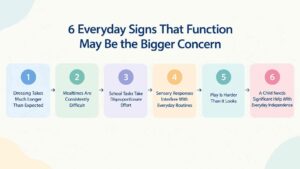
1. Dressing Takes Much Longer Than Expected
While a child may know how to dress in theory, they may still have issues with fasteners, clothing textures, sequencing, or frustration.
The function question is:
Does the child participate in morning dress, within a reasonable amount of help?
But if it is turning out to be an exhaustive, nerve-wracking procedure that they do in and out of each single working day, then perhaps cover it with a paediatrician or OT.
2. Mealtimes Are Consistently Difficult
Issues with mealtimes can arise from a very narrow range of food, not being able to use cutlery, texture responses, and trouble sitting at a family meal.
Being a picky eater does not automatically mean that the child needs OT. The larger query is if nutrition, family routines, participation, etc., are being affected by eating difficulties.
3. School Tasks Take Disproportionate Effort
Others can write, cut, color, or use classroom supplies, but it takes so much more effort than the rest of the kids.
Writing may cause fatigue. Cutting may take much longer. Organizing materials may be difficult. A little one might reject what is hands-on in the classroom because it takes a lot of energy to do.
4. Sensory Responses Interfere With Everyday Routines
Some sensory responses can get in the way of everyday rituals.
Intense feelings in response to auditory stimulation, clothing, tactile inputs, mobility, or over-excited environments can turn typical daily life into a challenge.
Sensory differences do not need to be right “sometimes.” The clinical question is whether or not they impact participation, safety, comfort, or independence.
5. Play Is Harder Than It Looks
The child plays but has challenges using toys, coordinating movements, joining peers, playing on the playground equipment, or play changes.
It may be more informative to look at a child’s play than just get a “Yes” or “No” answer to the ‘question’ of whether they play.
6. A Child Needs Significant Help With Everyday Independence
A child who requires assistance in the fundamentals of daily autonomy.
Difficulty with hygiene, feeding, dressing, toileting, packing to leave things behind, or taking care of your body every day may suggest the need to investigate function.
Children often find the support needed. The flip side of that is where the aid provided is permanent or excessive or undermines a child’s independence.
Sensory Regulation: It’s About Participation, Not “Fixing” Sensory Differences
Children can respond differently to:
- Noise
- Light
- Touch
- Movement
- Smells
- Crowded environments
OT should not necessarily react to these differences as needing to be removed. Rather, an OT might assess the environment, the activity, what drives the child’s interest or motivation, demands of a routine, and tools that can facilitate participation.
For instance, if you have a child who starts crying every day in the morning while he is dressing up.
Instead of asking only: How do we get the child accustomed to these clothes? An OT may look at the entire routine:
Clothing + Sensory Needs + Sequencing + Time Constraints and Space Between Words
Maybe the clothing feels uncomfortable. One possibility is that there are too many instructions in a push. Perhaps the child struggles to get from step A to B. Perhaps hastening begets difficulty in the situation.
That wider lens is the function-first perspective. OT was similarly defined in SOS therapy services, which frames occupational therapy as focusing on increasing independence and participation with sensory regulation, self-care, coordination, or other functional skills.
OT vs. Developmental Variation: When Should Parents Be Concerned?
Children grow at different rates. Not being able to cope sometimes does not mean therapy is needed. Some children will get better on their own as they become more experienced.
Recognize that OT is more relevant when challenges are chronic or significantly impact daily activity engagement.
Ask yourself:
- Is the difficulty happening repeatedly?
- Is it affecting home routines?
- Is it affecting school?
- Is it limiting play?
- Is it causing significant frustration?
- What can they do, and when will their efforts be recognized?
- Is independence being limited?
- Is safety affected?
In no case do parents have to play doctor. If anything consistently feels harder than it should, that is reason enough to talk with a qualified professional.
The Function Impact Checklist
“Is This Difficulty Affecting Function?”
Use this checklist as an educational tool, not as a diagnostic instrument.
- Participation: Does my child avoid or struggle to participate in everyday activities?
- Consistency: Can my child perform the skill only occasionally or under very specific conditions?
- Independence: Does my child need significantly more assistance than expected?
- Efficiency: Does the task take substantially longer or require much more effort?
- Regulation: Do sensory or emotional responses regularly interfere with the activity?
- School: Does the difficulty affect classroom participation or school routines?
- Home: Does it disrupt dressing, eating, hygiene, or family activities?
- Play: Does it limit play, movement, or participation with peers?
- Safety: Does the difficulty create a safety concern?
- Impact: Is it affecting confidence, independence, or everyday participation?
One “yes” does not mean a child needs OT. Several persistent concerns may be a reason to discuss the situation with a pediatrician or occupational therapist.
When Should You Talk With a Pediatrician or OT?
Consider talking with a pediatrician or OT when difficulties:
- Persist over time
- Interfere with everyday activities
- Affect school participation
- Limit play or social participation
- Affect feeding or self-care
- Create safety concerns
- Cause substantial frustration
- Reduce independence
A pediatrician can ascertain if a further evaluation is warranted. An occupational therapist can assess a child in functional activities and areas that may benefit from OT.
Research also backs the focus of meaningful activity. A systematic review of 129 articles evaluated a total of 52 occupational therapy interventions for 22 diagnoses and identified that the greatest number of supported interventions addressed the activity level of functioning.
That matters because therapy is more than just focusing on developing a specific skill in isolation. The long-run intention is simply understanding a baby to be able to use these capacities in regular life.
The Goal of OT Is Bigger Than Meeting Milestones
And that a child can have a skill but needs support using that skill in the world.
The goal when you are thinking about why do kids need occupational therapy is not simply:
“Can the child do it?”
It is:
Is the child able to apply the skill in their participation, learning, playing, or over both their daily routines and independence?
That is the function-first lens.
Occupational therapy at Success On The Spectrum is complemented by other therapies directed towards autism and developmental delays. SOS provides ABA therapy, speech therapy, occupational therapy, and social skills programs to allow families access to many services in one place while fostering coordination across domains of development.
Is Everyday Function Getting in the Way?
If dressing, feeding, handwriting, play, sensory regulation, coordination, or another everyday activity is becoming difficult for your child, an individualized occupational therapy evaluation can help identify what may be getting in the way.
Find a Location near you and schedule a Pediatric Occupational Therapy Evaluation
FAQs
Not necessarily. Whether a child qualifies for OT depends on the setting, referral requirements, insurance, and the child’s individual needs. A pediatrician or occupational therapist can help determine whether an evaluation is appropriate.
Yes. The academic lesson is only one component of functioning. So while there is difficulty with dressing, feeding, hygiene, coordination, sensory regulation, or any other item from activities of daily living (ADLs), a kid can still thrive in school.
An OT usually assesses function and the ability of children to participate in age-appropriate activities. The assessment can challenge your motor skills, self-care ability, sensory response, coordination, and other functional areas like routines.
Look at the impact. If a child is making little but cumulative progress with regular practice, simply accumulating more experience might work. A challenge is considered a concern to be discussed with an OT if it continues for a longer time and more support is needed, or if there is frustration or interference in daily participation.
Yes. This will ultimately aid in establishing OT goals that are specific to the interests of the child and acknowledge their individual shifting needs. With progress made in one area as children become more independent, therapy goals can target other functional areas of participation and daily life.

Nichole Daher is an American entrepreneur, book author, autism advocate, and founder of Success On The Spectrum (SOS)-the first autism treatment franchise in the United States-known for its parent viewing rooms and quality-driven ABA services.