

Key Takeaway
Speech therapy happens all day, not just in our speech sessions. Mealtimes, play, reading, shopping, bedtime. This routine develops speech, language, and AAC skills. You can help your child by modeling language, providing true choices, allowing time to respond, following their lead, and celebrating every aspect of communication–words, gestures, sounds, all of it.
Have you ever wondered what is speech therapy for kids?
Speech therapy should not have to feel like one more thing on your to-do list. The most important part of all the best practices happens right in the midst of practical things your kid is already doing: breakfast, getting dressed, messing about, reading a book together, grocery shopping, bath time, car rides, chores, even bedtime. These moments provided you with an excuse to talk, a conversation that felt so unscripted.
One thing to keep in mind is that communication goes beyond a child producing their sounds clearly. Others need support to understand what has been communicated to them. Some struggle to find words, form sentences, initiate conversation, or use alternate forms of communication altogether.
In truth, it was never simply about getting a child to speak more. It’s about assisting them in articulating what they mean, helping them understand others, participate in, and share in everyday life moments. Let’s understand speech therapy tips for kids.
Speech vs. Language: What Are You Actually Practicing?
It helps to know what you are working on. But before anything, we need to understand what is speech therapy for kids.
Speech can include:
- Producing speech sounds
- Pronunciation and articulation
- Speech clarity
- Sound patterns
Language includes:
- Understanding what others say
- Using words and sentences
- Vocabulary and grammar
- Expressing wants, needs, thoughts, and ideas
Social communication includes:
- Taking turns
- Starting interactions
- Responding to others
- Maintaining conversations
- Using communication in different situations
Some children communicate through speech, while others use gestures, signs, pictures, or speech-generating devices. These are all valid ways to communicate. Experts say about 10% to 20% of two-year-old children have late language emergence.
Our goal is not simply to get a child to say more words. It is to help the child communicate effectively in everyday life.
12 Everyday Speech Therapy for Kids
1. During Breakfast: Create Choices
Communication target: Requesting, choosing, and vocabulary
Give your child two meaningful choices:
- “Toast or cereal?”
- “Milk or water?”
- “Banana or apple?”
Then wait for a response.
If your child points to cereal, you can say, “Cereal. You want cereal.” You are modeling useful language without making your child repeat it.
2. Getting Dressed: Talk Through the Routine
Communication target: Vocabulary, directions, and sequencing
Talk about what you are already doing:
- “Shirt on.”
- “Where are your socks?”
- “First pants, then shoes.”
- “Blue shirt today.”
Let your child help find clothing or choose between two options.
Try not to turn the routine into a quiz by constantly asking, “What is this?” Modeling useful words in context is often more natural.
3. During Play: Follow Your Child’s Lead
Communication goal: Vocabulary, social communication, and turntaking
Start small with something your child likes.
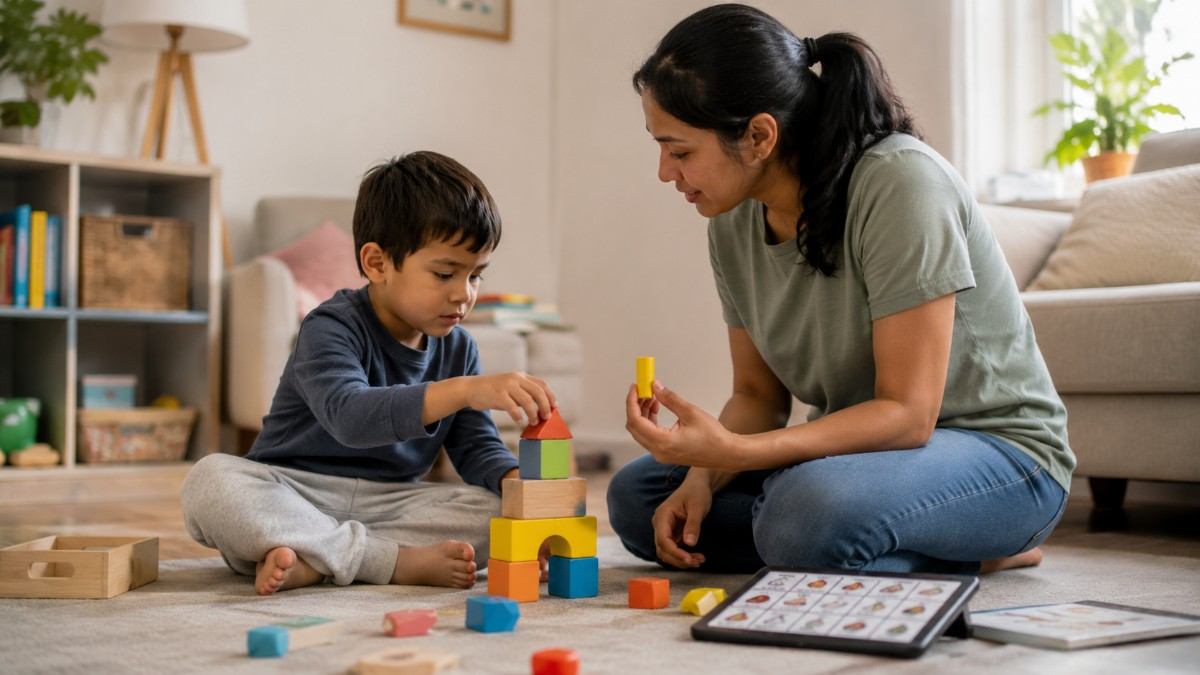
For instance, if they were working with blocks, you could say:
- “More blocks.”
- “Big tower.”
- “It fell!”
- “Build again.”
To do this, you will want to join the play as opposed to directing every single move. For example, when a child is engaged in what they are doing, then the functions of communication tend to happen spontaneously.
4. Snack Time: Create a Reason to Communicate
Communication target: Requests, functional language, and vocabulary
Snack time can be a simple opportunity to practice:
- “More”
- “Finished”
- “Help”
- Food names
- Choices
You might offer two foods and wait for your child to choose.
Just avoid intentionally withholding food to force communication. The goal is to create opportunities, not frustration.
5. Reading Together: Comment More, Quiz Less
Your goal guide: Vocabulary, comprehension, Q&A, and speech
Instead of asking “What’s that?” on every page, make comments:
- “Look at the dog!”
- “The dog is running.”
- “He has a big ball.”
- “I think he’s going home.”
When reading a well-known story, pause before saying a repeated line and allow your child to say it how they can.
Reading should be like spending time with someone, not an exam.
6. Bath Time: Use Repetition
Communication target: Action words, body parts, and following directions
Bath time has a familiar sequence, so use simple, repeated language:
- “Wash hands.”
- “Wash hair.”
- “Water on.”
- “All done.”
- “Towel time.”
Because the routine happens regularly, your child gets repeated opportunities to hear and use the same words.
7. Cleanup: Practice Directions and Concepts
Communication target: Understanding language, directions, and concepts
Turn cleanup into a simple language activity:
- “Put the cars in the box.”
- “Find the red block.”
- “First blocks, then books.”
- “Where does this go?”
If spoken directions are difficult, add gestures, pictures, or other visual supports.
8. Grocery Shopping: Practice Real-World Communication
Communication target: Vocabulary, requesting, and social communication
The grocery store gives you plenty to talk about:
- Foods
- Colors
- Sizes
- Quantities
- Preferences
- Locations
Try:
“Can you find the milk?”
“We need apples.”
“Red or green?”
Keep the expectations appropriate to your child’s communication level. The point is to practice language they can actually use outside therapy.
9. Car Rides: Turn Waiting Into Conversation
Communication target: Commenting, describing, and social communication
Talk about what you see:
- “I see a bus.”
- “That truck is big.”
- “We’re going home.”
- “Look at that red car.”
If your child enjoys answering questions, ask what they see. If not, simply make observations.
And remember, you do not have to fill every quiet moment with questions. Sometimes listening and sharing the ride is enough.
10. Household Chores: Give Functional Directions
Communication target: Following directions, sequencing, and vocabulary
Everyday chores can become useful communication practice:
- Sorting laundry
- Setting the table
- Putting toys away
- Feeding a pet
- Carrying items
Start with short directions and gradually add steps as your child is ready.
For example:
“Get the spoon.”
Later:
“Get the spoon and put it on the table.”
11. Waiting for Something Fun: Practice Turn-Taking
Communication target: Social communication, anticipation, requesting, and turn-taking
Try predictable games such as:
- “Ready, set… go!”
- Taking turns with a ball
- Building together
- Blowing bubbles
- Choosing songs
Pause before the fun part. During “ready, set, go,” for example, give your child a chance to communicate before you say “go.”
A word, gesture, sound, sign, or AAC response can all count as participation.
12. Bedtime: End the Day With Conversation
Communication target: Recalling events, vocabulary, and social communication
Keep bedtime conversations simple:
- “What was fun today?”
- “We went to the park.”
- “You played with blocks.”
- “Tomorrow we’ll go to school.”
If broad questions are difficult, offer choices:
“Did you play inside or outside?”
That gives your child an easier way to participate.
5 Speech Therapy Strategies Parents Can Use Across Any Routine
1. Model Instead of Correcting
If your child says, “Dog run,” you can say, “Yes, the dog is running.”
You are giving them a better language model without stopping the conversation to correct them.
2. Give Wait Time
Pause after speaking or asking a question. Some children need extra time to process language and decide how they want to respond.
3. Offer Choices
Two meaningful options can make communication easier:
“Apple or banana?”
“Red shirt or blue shirt?”
4. Expand What Your Child Says
Child: “Car.”
Parent: “Yes, a red car!”
Add a little more language without asking your child to repeat the whole sentence.
5. Follow Your Child’s Interests
If your child loves trains, use trains to talk about colors, actions, locations, numbers, and taking turns.
Communication is easier when there is something worth talking about.
Make Everyday Practice AAC-Friendly
Spoken words are not the only measure of successful communication.
AAC, or augmentative and alternative communication, may include:
- Gestures
- Signs
- Picture boards
- Communication books
- Speech-generating devices or apps
ASHA states that AAC can help or replace spoken communication and that there are no specific skills required before considering AAC.
Parents can support AAC by:
- Keeping the child’s system available
- Modeling words while speaking
- Using AAC during normal routines
- Starting with useful, familiar words
- Not requiring speech before allowing AAC
For example, during snack time, model words such as “more,” “finished,” “help,” or the names of preferred foods on the child’s communication system.
AAC should be available throughout the day, not only during therapy.
At Success On The Spectrum, speech therapy supports children with different communication profiles, including children who are non-speaking or use alternative communication methods.
When Should You Talk With an SLP?
Consider an evaluation with a speech-language pathologist (SLP) when communication difficulties affect:
- Expressing wants and needs
- Understanding instructions
- Being understood
- School participation
- Playing with peers
- Conversations
- Social communication
- Feeding or swallowing, when relevant
Not all SLP evaluations are for children who just don’t talk.
A child is using sentences but needs support in the areas of speech clarity, language comprehension, expressing ideas and thoughts clearly, social voice communication skills, or more specific aspects of functional use of speech.
Developmental milestones can be a helpful clue, but they do not serve as a diagnosis. The 19–24-month communication milestones set by ASHA include using and understanding at least 50 different words. Since children develop at different rates, a milestone checklist serves as an indicator of concern rather than as a diagnosis on its own.
Communication profiles among children with autism vary widely from child to child. An SLP can assess your child in order to find out what your child may be good at and what would be helpful for them.
Common Parent Mistakes to Avoid
Mistake 1: Turning every interaction into a test
Constantly asking “What is this?” or “Say ___” can make communication feel like an exam.
Mistake 2: Correcting every error
For example, a child is able to communicate without saying everything in the right way.
Mistake 3: Asking for repetition too often
If what you do is repeat the word your child already communicated successfully, there really is no point in them saying it again.
Mistake 4: Practicing only at a table
Communication should also transfer into meals, playtime, school activities, and community activities.
Mistake 5: Ignoring nonverbal communication
Various means of communication, including pointing, gestures, signs, pictographs, AAC, and otherwise, are worthwhile attempts at communication.
Mistake 6: Comparing children
Every child develops communication skills differently. Focus on your child’s progress rather than comparing them with another child.
Make Communication Part of the Day, Not Another Assignment
You do not need to set aside a long speech practice session every evening.
Look at the routines you already have:
Breakfast → choices
Getting dressed → vocabulary
Play → modeling
Reading → commenting
Snack → requesting
Shopping → real-world language
Transitions → functional communication
Bedtime → conversation
These small moments add up.
When communication is connected to something a child wants, enjoys, or needs to do, it becomes meaningful. That makes it more useful than practicing isolated words without a real purpose.
When Your Child Needs More Than Everyday Practice
These speech therapy tips for kids can be used by parents in everyday life to facilitate communication. However, if extra support is required, these are not a substitute for speech therapy.
An SLP evaluation can help clear that up if you are not sure if your main question is the speech sounds that comprise articulation, understanding language, expressive language, social communication skills, AAC, or some other area of concern.
At Success On The Spectrum, we build our pediatric speech therapy services around the unique needs of each child in terms of both social and alternative communication.
Wondering About What Kind Of Speech Support Your Child Really Needs?
A special pediatric speech therapy evaluation will be able to determine your child’s strengths and challenges & aid in setting a new communication goal.
Find your location for Speech Therapy Evaluation
FAQs
Follow their interests, model useful language, offer choices, and give them time to respond. Accept gestures, signs, pictures, and AAC as communication rather than making spoken words the only acceptable response.
Use a warm, natural voice and language your child can understand. You can keep sentences simple when needed, but model language that is appropriate for your child's level.
Yes. Daily routines give children opportunities to request, choose, comment, answer, and express their needs. Give them time to respond and model language without requiring repetition.
Siblings can read together, play games, build, take turns, or choose songs. Keep it natural. Siblings do not need to become therapists; they can simply provide opportunities for genuine interaction.
Look at what changes between environments. Noise, unfamiliar people, transitions, or different expectations can affect communication. Share your observations with your child's SLP and school or care team so they can identify appropriate supports.

Nichole Daher is an American entrepreneur, book author, autism advocate, and founder of Success On The Spectrum (SOS)-the first autism treatment franchise in the United States-known for its parent viewing rooms and quality-driven ABA services.