

Summary
Occupational therapy with kids is about more than just handwriting. It assists children in performing daily tasks like dressing, eating, playing, learning, and self-care. In OT, the child, activity, and environment are examined together to recognise barriers to greater independence; functional goals are helpful in measuring meaningful progress when setting objectives across home, school, and community.
“Occupational therapy is just for handwriting.”
That’s a common misconception about pediatric OT. While handwriting can be one reason a child receives OT, it’s only one small part of what OT can address.
Pediatric OT applies the therapist’s skill set to everyday challenges like dressing, eating, playing, and learning, and in supporting a routine with use of their hands so they can be independent.
The central idea is simple:
This isn’t just a skill to be taught in Occupational therapy. It examines the child, activity, and environment as a whole to determine what is preventing participation with regard to that specific task.
In a CDC analysis of 44,299 children, 17.3% had a developmental disability; among these children, 5.7% had limited ability to move or play and 4.7% needed help with personal care.
At the end of this guide, parents will learn what pediatric OT does, who can benefit from it, what is involved in an evaluation before starting OT services, how goals are set, and how progress is monitored.
What Is Occupational Therapy?
Start with the word “occupation.”
In OT, an occupation is not simply a job. It means the meaningful activities a person needs or wants to do in everyday life.
For children, these occupations may include:
- Getting dressed
- Eating
- Sleeping
- Playing
- Learning
- Participating at school
- Interacting with peers
- Completing hygiene routines
- Taking part in family activities
- Developing independence
OT framework emphasizes understanding what a person wants and needs to do, what they can do, and what supports or barriers affect their participation.
About 1 in 6 (17%) U.S. children ages 3–17 have one or more developmental disabilities.
Key Takeaway
OT asks: “What does this child need and want to do, and what is getting in the way?”
That answer will look different for every child.
What Are “Occupations” for Children?
Daily Living
OT may support activities such as:
- Dressing
- Eating
- Bathing
- Toileting
- Grooming
- Toothbrushing
School and Learning
This can include:
- Writing
- Cutting
- Using classroom tools
- Managing materials
- Participating in routines
Play and Leisure
Children may need support with:
- Playing with toys
- Using playground equipment
- Participating in games
- Exploring hobbies
Social Participation
This can involve:
- Playing with peers
- Joining group activities
- Participating in family activities
- Taking part in community experiences
Rest and Routines
OT might work on bedtime routines, sleep hygiene, or transitions between one activity and another.
The thing is, OT might work on those foundational skills, but it is these skills that are important because they lead to participating in meaningful occupations.
Who Can Benefit From Pediatric Occupational Therapy?
Specializing in Pediatric OT is not just a small group of children with specific diagnoses.
Children with developmental, integrated neurologic or sensory, motor, cognitive, or other limitations may be helped when such limits affect everyday participation.
Potential examples include:
- Autism
- Developmental delays
- Cerebral palsy
- ADHD
- Down syndrome
- Coordination difficulties
- Fine-motor challenges
- Sensory-related difficulties
- Self-care challenges
- School participation difficulties
The OT Goals are not automatically diagnosis-based.
Two children with the same diagnosis may require completely different levels of functional assistance. You may have difficulty with responding in conversations, while another one requires help dressing; the other may need support around handwriting, play, eating, or sensory needs.
It depends on each child and the factors affecting their involvement.
How Does an OT Know What a Child Needs?
Assessment comes before intervention.
An OT evaluation is not simply a test of whether a child can perform individual skills. It considers how those skills affect everyday activities.
An OT may look at:
- What the child can do
- What the child struggles with
- Activities that matter to the family
- Sensory and motor factors
- Daily routines
- School participation
- Environmental demands
- Current supports
- Caregiver concerns
- The child’s strengths and interests
In AOTA’s pediatric evaluation checklist, occupations include dressing, bathing, grooming, feeding, toileting, education and sleep, play and leisure, performance skills, routine, environment, safety, and caregiver priorities.
A useful framework is: Skill → activity → environment→ participation
Using an example, the child might be struggling with fine-motor control. An OT does not just ask if the child can move their fingers. The OT will want to know how that difficulty impacts writing, eating, dressing, or playing.
How Are OT Goals Chosen?
OT goals should be functional and measurable.
Instead of:
“Improve fine-motor skills.”
A more functional goal might be:
“Use a pencil to complete a classroom writing activity with less assistance.”
Instead of:
“Improve sensory regulation.”
A functional goal might be:
“Participate in the morning dressing routine using an agreed-upon support strategy.”
Goals may depend on:
- Current abilities
- Family priorities
- School needs
- Functional challenges
- Safety
- Developmental level
- Environmental demands
The goal should connect therapy to something meaningful in the child’s everyday life.
What Does OT Treatment Actually Look Like?
OT does not always involve traditional exercises. Treatment can look different depending on the child’s goals.
Practicing the Occupation
A child may practice:
- Dressing
- Using utensils
- Writing
- Cutting
- Playing
- Completing hygiene routines
Building Supporting Skills
An OT may work on:
- Coordination
- Motor planning
- Strength
- Visual-motor skills
- Fine-motor control
These skills matter because they support participation.
Modifying the Environment
An OT may also consider:
- Changing materials
- Adjusting positioning
- Reducing unnecessary distractions
- Using visual supports
- Adapting tools
Sometimes changing the environment can make an activity more accessible.
Teaching Strategies
Strategies may include:
- Breaking routines into steps
- Using prompts
- Building predictable routines
- Teaching alternative ways to complete a task
Sensory Skills and OT: What Parents Should Know
Sensory concerns are often part of pediatric OT.
Children may respond differently to:
- Sounds
- Textures
- Movement
- Lights
- Smells
- Crowded environments
These variations are particularly relevant during dressing, eating, school, play, community involvement, or normal routines.
Occupational therapy is more than “tolerating,” and you should not necessarily broaden your definition of OT to include teaching children to feel good despite sensory input.
OT, on the other hand, might help determine changes that could be made to an activity, environment, your child’s routine, or their supports that may allow a child to participate with greater success.
If a child has a challenging time during an active morning routine, the OT will investigate beyond just the parent’s reaction to that-even more than clothing, environment, number of instructions given, transitions, and timing are investigated.
This is not about making all children respond to sensory experiences in the same way; it is about participation.
How Is Progress Measured in Occupational Therapy?
Progress is not simply:
“Did the child perform the skill once?”
A child may complete a task once with significant prompting but still need substantial support in everyday situations.
Meaningful progress can include:
Frequency
How often can the child perform the activity successfully?
Independence
How much assistance is needed?
Accuracy and Quality
How effectively can the child complete the task?
Time
Does the activity take a more reasonable amount of time?
Participation
Can the child remain engaged in the activity?
Generalization
Can the child use the skill with different people, materials, or environments?
Support Level
Does the child need fewer prompts, adaptations, or adult assistance?
AOTA identifies outcomes such as occupational performance and participation as important ways to evaluate the results of OT intervention. It also recommends reviewing outcomes regularly and modifying intervention when needed.
This keeps progress connected to the child’s actual goals rather than an isolated skill.
OT at Home and School: Making Skills Transfer
A child does not live inside the therapy room. Skills need opportunities to transfer into everyday settings.
At Home
Families may support:
- Dressing routines
- Mealtimes
- Hygiene
- Play
- Bedtime
- Household routines
At School
OT goals may connect with:
- Classroom materials
- Writing
- Cutting
- Positioning
- Transitions
- Classroom participation
School-based OT can also involve collaboration with other professionals to support a student’s access to and participation in their educational program.
Community
Children may need to use their skills in:
- Stores
- Parks
- Restaurants
- Community events
- Social activities
Generalization is important because meaningful progress should extend beyond the therapy session.
Common Occupational Therapy Myths
Myth 1: There is only OT for handwriting
Reality: Only the handwriting part of it. OT can include activities focusing on daily living, play, sensory and motor, school participation, and independence.
Myth 2: My child needs a diagnosis
Fact: Functional needs and participation are considerations. Diagnosis alone does not make OT goals.
Reality: Therapy groups or personal trainers might conduct OT with their patients, but that’s far from the entirety of its practice.
Myth: OT is the absence of activity
Reality: OT does include meal preparation, home modifications, assistive devices, activities of daily living (ADLs), and caregiver training.
Myth 4: “Progress equals achieving every developmental milestone.”
Reality: Progress should not be measured by connectedness, but by individualized goals and meaningful participation.
Myth 5: My therapy is only during the session
Reality: Steadily carrying skills into home, school, and community environments is not an essential piece of meaningful progress.
OT vs. PT vs. Speech Therapy: What’s the Difference?
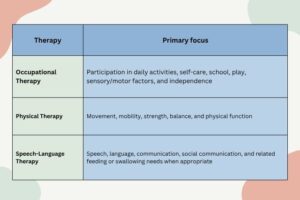
These disciplines can overlap, and some children benefit from more than one type of therapy.
Clinically Reviewed Pediatric OT Glossary
- Occupation: Activity or task requiring physical effort for a purpose in everyday life.
- Participation: Participation is taken to involve engagement in meaningful tasks and life circumstances.
- Activities of Daily Living (ADLs): Basic self-care activities such as dressing, eating, bathing, and grooming.
- Fine-Motor Skills: Coordination of the hands and fingers for activities like writing or using devices.
- Visual-Motor: The connection between movement and vision.
- Sensory Processing: The way in which a person receives, organizes, and responds to sensory information.
- Self-regulation: The ability to regulate in an adaptive manner during actions based on internal demands and external environmental cues relevant for performing participation.
- Adaptive Equipment: The tools or modified equipment to carry out an activity more safely or more accessible.
- Generalization: Transferring a skill you learned with a specific person, place, material, or situation.
- Functional Goal: A measurable goal, linked to meaningful participation in daily living.
The Bottom Line: OT Measures What Matters in Everyday Life
Occupational therapy is not the determination of whether the child can carry out a skill.
It’s whether that skill allows the child to live a normal life.
From a high level, the process can be seen simply as follows:
Evaluate the child → establish purposeful occupations → clarify limitations → set functional objectives and goals → engage or modify → generalize skills to real-world settings → assess meaningful change over time.
The function-first model of therapy keeps the focus where it matters most, on using this information, along with all the other data you gather during your evals, to get them active and engaged in their participation, learning, play, daily routines, and increasing independence.
See How Pediatric OT Can Support Your Child
A pediatric OT evaluation evaluates your child in the context of dressing, feeding, handwriting, play skills, sensory regulation, and coordination. All areas that affect daily life functioning, whether at home or at school. A pediatric OT evaluation can help determine barriers to participation and possible means of facilitation in the presence of a concern in these areas.
Schedule a Pediatric Occupational Therapy Evaluation
Services are customized specifically to the child and their family at Success On The Spectrum. Functional challenges impacting around the level of everyday participation, occupational therapy can be considered in a wider package of support.
FAQs
There is no single timeline. OT duration is based on the needs, goals, progress, and response to intervention by the child.
Frequency is determined by the findings, objectives, and needs of the child as well as his or her individual plan for treatment.
Yes. Getting the caregiver involved brings therapy strategies to life in what a child does at home, in their everyday routines and activities.
Yes. A child's needs and daily activities change as they grow, so OT goals can change as independence develops and new challenges arise.
Look for a qualified pediatric OT who takes time to understand the child's strengths, challenges, routines, and family priorities and connects therapy goals to meaningful everyday activities.

Nichole Daher is an American entrepreneur, book author, autism advocate, and founder of Success On The Spectrum (SOS)-the first autism treatment franchise in the United States-known for its parent viewing rooms and quality-driven ABA services.