Summary
The function of behavior helps explain why a child may scream, hit, refuse, or repeat behaviors. Behavior may seek attention, escape, access preferred items, meet sensory needs, or communicate discomfort. By observing what happens before and after, parents can identify patterns, teach functional replacement skills, reinforce appropriate communication, and seek professional support when needed.
“Why does my child keep doing this?”
Many parents ask this when a child screams during cleanup, hits when a sibling gets attention, cries when a favorite activity ends, or repeats a particular sound.
It can be tempting to call the behavior defiant, manipulative, or attention-seeking. But these labels describe the behavior; they don’t explain why it happens.
In behavior analysis, the 5 functions of behavior refer to what the behavior may accomplish or what outcome may maintain it. A child may use behavior to seek interaction, escape something difficult, access something preferred, or meet a sensory need.
Understanding function doesn’t excuse challenging or unsafe behavior. It helps adults identify patterns and teach more functional ways to communicate and participate.
The goal is to understand what happens before and after a behavior and what the child may be communicating or experiencing.
What Does “Function of Behavior” Mean?
Think of it simply as:
Behavior → Outcome
A function describes what a behavior may help a person:
- Obtain
- Avoid
- Change
- Communicate
- Experience
Imagine a child throws a worksheet across the room.
The behavior is easy to observe. But the behavior alone does not tell us why it happened.
Maybe the child wants an adult’s attention.
Maybe the worksheet is difficult, and throwing it helps the child escape the task.
Maybe the child wants access to a tablet that was removed.
Maybe the child is overwhelmed by the environment.
Or perhaps the child is experiencing pain or another physical problem.
This is the key distinction:
Behavior = what you can observe.
Function = what the behavior may be accomplishing.
That distinction can change how parents approach challenging behavior.
The 5 Functions of Behavior
Function 1: Social Attention or Interaction
Sometimes behavior is followed by social interaction.
The child may receive:
- Conversation
- Eye contact
- Comfort
- Physical interaction
- Help
- Reassurance
- A shared activity
For example:
Before: A parent begins talking to someone else.
Behavior: The child repeatedly interrupts and screams.
After: The parent stops the conversation and responds to the child.
The behavior may be related to obtaining social interaction.
It is easy to call this “attention-seeking,” but that phrase can miss what the child is actually trying to communicate.
The child may be saying:
- “Talk to me.”
- “I want to play.”
- “I need help.”
- “I need reassurance.”
- “I don’t know when I can talk to you.”
The goal is not to teach a child that wanting attention is wrong. Children naturally need connection and interaction.
Instead, parents can teach a more appropriate way to request it.
Depending on the child’s communication abilities, that might include:
- Saying, “Play with me.”
- Tapping an adult appropriately
- Using a visual signal
- Asking for attention
- Waiting with a visual support
- Using a communication device or AAC when appropriate
The replacement should give the child a practical way to achieve the same general need.
Function 2: Escape or Avoidance
Behavior can also help a child escape, delay, or reduce something they find difficult.
This might involve:
- Escaping a demand
- Delaying a task
- Avoiding a transition
- Leaving an overwhelming environment
- Getting a break
- Reducing task difficulty
Consider this example:
Before: A math worksheet is presented.
Behavior: The child pushes the materials away and screams.
After: The worksheet is removed.
If this pattern happens repeatedly, escape from the task may be part of the behavior’s function.
That does not necessarily mean the child is being “defiant.”
Instead, ask:
What is difficult about this situation, and what skill could help my child communicate that?
A child might learn to:
- Say “help.”
- Request a break
- Ask for assistance
- Appropriately refuse
- Request a smaller step
- Communicate that a task is too difficult
There may also be other factors to consider. The task could be too challenging, instructions may be unclear, or the child may not yet have the skills needed to complete it independently.
Understanding the function gives adults more information to work with.
Function 3: Access to Tangibles or Activities
Sometimes a behavior is followed by access to something the child wants.
This may include:
- A toy
- Food
- A tablet
- A video
- A preferred activity
- A specific object
- Access to a person or location
For example:
Before: A tablet is removed.
Behavior: The child screams and reaches for it.
After: The tablet is returned.
The behavior may be related to gaining access to the preferred activity.
This is different from social attention. The child may not primarily want interaction with the adult. They may want the tablet.
Replacement skills can include:
- Requesting
- Pointing
- Using AAC
- Making a choice
- Asking for “more”
- Waiting
- Requesting a specific activity
- Learning to accept “not now”
Again, the goal is not simply to remove the behavior.
The goal is to give the child a functional way to communicate what they want while also teaching skills such as waiting, flexibility, and accepting limits when appropriate.
Function 4: Automatic or Sensory Outcomes
Some behaviors may continue because they produce an outcome for the person without depending primarily on another person’s response.
For example, a behavior may:
- Produce sensory stimulation
- Reduce or change sensory input
- Create a repetitive or predictable experience
- Have an internally reinforcing effect
Imagine a child repeatedly engages in a particular movement even when no one is responding.
An automatic or sensory outcome may be part of the reason the behavior continues.
However, parents should avoid automatically labeling every repetitive movement as “sensory-seeking.”
The appearance of a behavior does not tell you its function.
Context and patterns matter.
Depending on the situation, support may involve:
- Appropriate alternative sensory activities
- Environmental modifications
- Functional communication
- Teaching alternative ways to meet the relevant need
- Working with an occupational therapist when sensory or functional participation concerns are present
The right approach depends on the individual child.
Function 5 — Pain, Physiological, or Medical Needs
Sometimes behavior changes may be related to pain, illness, physical discomfort, or another medical need rather than a typical behavioral function.
Possible factors include:
- Pain or illness
- Poor sleep
- Hunger or thirst
- Gastrointestinal discomfort
- Medication effects or changes
- Dental or other physical discomfort
Example:
Before: The child seems uncomfortable or behaves differently than usual.
Behavior: The child suddenly screams, cries, or becomes unusually irritable.
After: The underlying discomfort is identified and addressed.
A sudden behavior change should not automatically be labeled as attention-seeking or escape behavior. Look for changes in sleep, eating, energy, mood, or physical comfort, and consult an appropriate healthcare professional when needed.
Important Reminder
The behavior itself does not tell the whole story. Observe what happens before and after the behavior, consider physical and environmental factors, and help the child develop safe ways to communicate their needs.
At Success On The Spectrum, individualized support starts with understanding the child rather than assuming one explanation fits every situation.
The Same Behavior Can Have Different Functions
One of the most important things for parents to understand is that the same behavior can serve different functions.
Consider screaming.
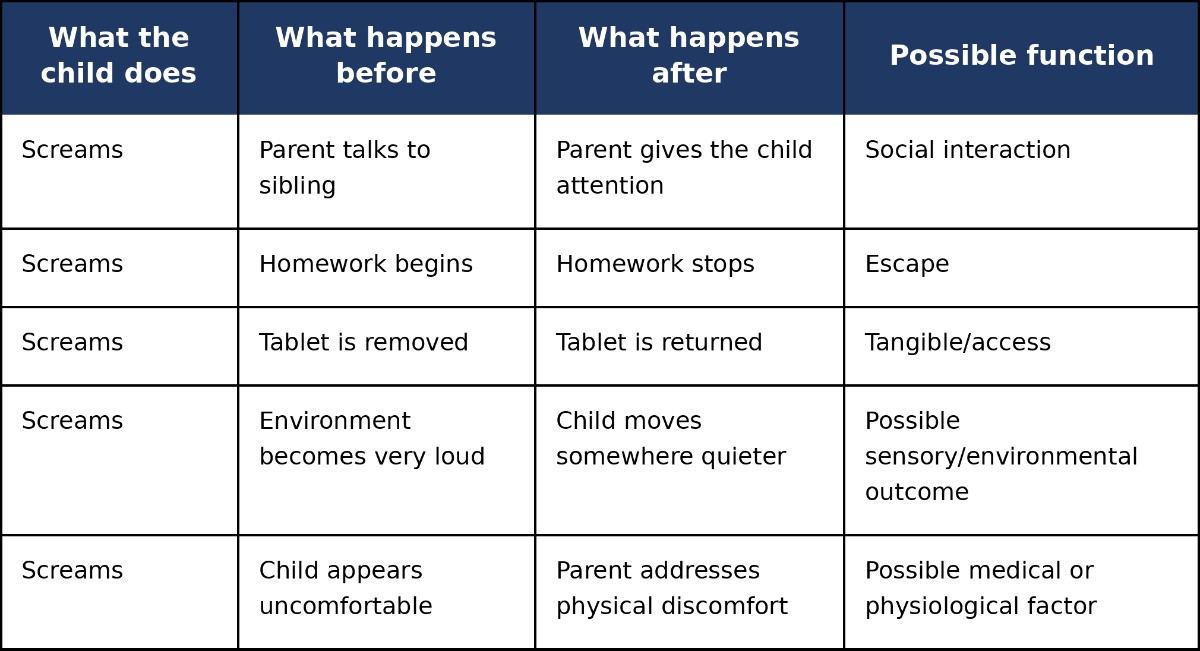
Possible medical or physiological factor
The behavior is the same: screaming.
The circumstances are different.
That is why you cannot determine a behavior’s function simply by looking at what the behavior looks like.
Behavior gives you a starting point for observation, not a complete explanation.
What Happens Before and After Behavior Matters
A simple way to begin looking for patterns is the ABC framework.
A — Antecedent
What happened immediately before the behavior?
B — Behavior
What exactly did the child do?
C — Consequence
What happened immediately afterward?
For example:
A: The parent says, “Clean up.”
B: Child throws toys.
C: Parent removes the cleanup demand.
If this sequence happens repeatedly, it may provide a clue that escape from the task is involved.
But one ABC sequence does not confirm a behavior’s function.
Parents should look for repeated patterns across situations rather than drawing conclusions from a single incident.
Don’t Guess the Function From the Behavior Alone
It is common to make quick assumptions.
“They screamed, so they wanted attention.”
Not necessarily.
“They ran away, so they were being defiant.”
Not necessarily.
“They are repeating that movement, so it must be sensory.”
Not necessarily.
“They hit, so they are trying to get something.”
Not necessarily.
The same behavior can occur for different reasons.
Instead of immediately assigning a label, ask:
What happened before?
What happened after?
What changed?
What might my child be trying to obtain, avoid, communicate, or experience?
This shift can help parents move from judgment toward observation.
Once You Understand the Function, Teach a Replacement
Function-based support is not simply about stopping challenging behavior.
If a behavior is helping a child communicate a need, the child needs another way to communicate that need.
For example:
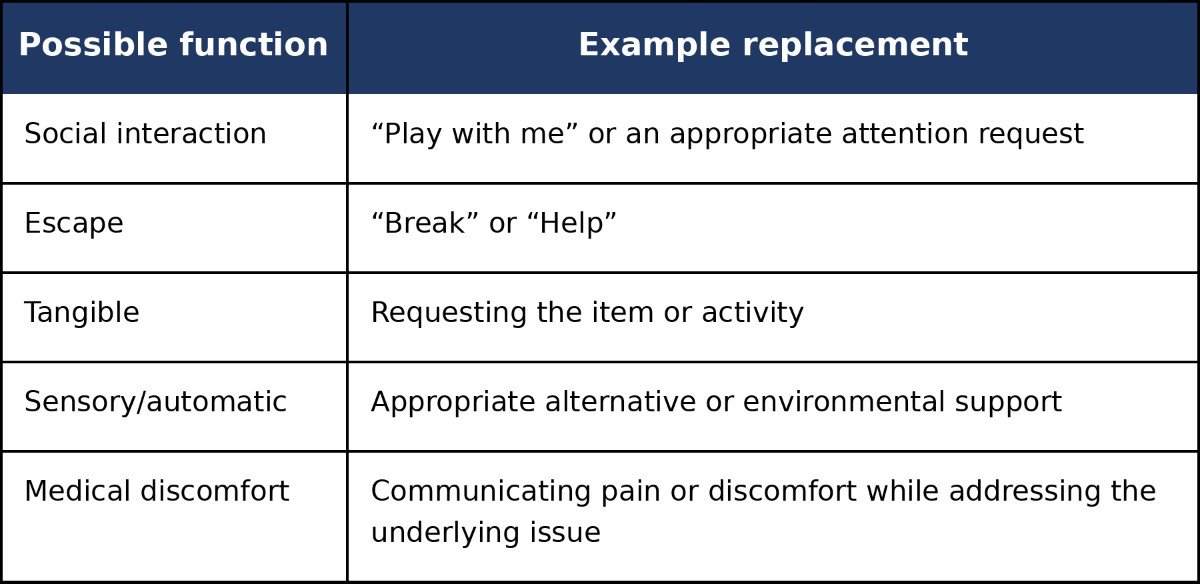
The replacement behavior should be practical for that particular child.
It should also be:
- Functional
- Age-appropriate
- Easy enough to use
- Practiced during calm moments
- Reinforced when used appropriately
For a child who screams when a task becomes difficult, teaching “help” is more useful than simply saying, “Don’t scream.”
For a child who grabs a parent’s arm for attention, teaching an appropriate attention request gives that child another option.
If challenging behavior communicates a need, teaching communication can be part of the solution.
How Parents Can Collect Useful Behavior Data
Parents do not need to diagnose the function themselves.
Simple observations can, however, help identify patterns that can later be discussed with a qualified professional.
Try recording:

Keep the descriptions objective.
Instead of:
“My child was being difficult.”
Write:
“I said it was time to turn off the tablet. My child screamed, dropped to the floor, and reached toward the tablet. I gave the tablet back.”
Specific observations are more useful than labels.
The purpose of tracking is to help identify patterns, not to ask parents to conduct their own functional assessment.
Download the Behavior Data PDF (Prepare a PDF using the format above to attach with the button)
What If You Can’t Identify the Function?
Sometimes the pattern is not obvious.
Professional support may be appropriate when behavior:
- Happens frequently
- Is becoming more intense
- Interferes with daily participation
- Affects school or community activities
- Is difficult to understand
- Includes aggression or self-injury
- Creates safety concerns
A qualified professional may use more comprehensive assessment methods, including principles of functional behavior assessment, to better understand the behavior and develop an individualized support plan.
When a Behavior May Need More Than a Behavior Plan
There is another important question parents should ask:
Could something physical be contributing to this change in behavior?
A sudden change in behavior can sometimes warrant medical attention, particularly when it occurs alongside:
- Suspected pain
- Sleep changes
- Eating changes
- Digestive problems
- Illness
- Signs of physical discomfort
- A significant change from the child’s usual behavior
Not every behavior problem is primarily a behavior-analysis problem.
Sometimes the first question should be whether something is physically wrong.
When a child suddenly begins engaging in a behavior that is unusual for them, discussing the change with their pediatrician or another appropriate healthcare professional can be an important step.
How ABA Can Use Function-Based Support
How ABA Can Support Functional Behavior Change
Individualized Applied Behavior Analysis (ABA) may use:
- Direct observation and ABC data
- Functional assessment
- Functional communication and replacement skills
- Reinforcement
- Environmental strategies
- Progress monitoring
- Caregiver involvement
At Success On The Spectrum, ABA is tailored to each child’s needs, goals, communication, and daily-life participation.
Parent involvement helps families recognize patterns, practice replacement skills, and reinforce progress across everyday routines.
Explore ABA Therapy at Success On The Spectrum.
Conclusion
Understanding behavior means looking beyond what we see.
A scream may communicate a need for attention, escape, access to something, sensory input, or even physical discomfort.
The goal is not to quickly label the behavior, but to identify patterns, teach functional replacement skills, and respond safely and appropriately.
A helpful framework is:
Observe → Identify → Consider the function → Teach a replacement → Reinforce → Monitor
When behavior is persistent, escalating, or unsafe, professional guidance can help families develop individualized support.
At Success On The Spectrum, individualized ABA and parent involvement focus on building meaningful skills children can use across everyday settings.
Want Help Understanding Your Child’s Behavior?
Individualized behavior support can help identify patterns, build communication skills, and teach functional alternatives.
Explore ABA Therapy at Success On The Spectrum.
FAQs
Look for repetition across similar situations. A single incident does not provide enough information to determine a behavior's function. Tracking what happens before and after the behavior over time can reveal patterns.
Yes. A behavior can have different functions in different situations, and the factors maintaining a behavior can change over time. That is why behavior should be considered in context rather than assigned one permanent label.
Communication skills can give children safer and more functional ways to express needs such as wanting attention, requesting help, asking for a break, accessing an item, or communicating discomfort. Functional communication can therefore be an important part of behavior support.
First, consider whether the replacement is easy enough for the child to use and whether it actually addresses the same need. A qualified professional can help adjust the skill, teaching approach, or environment when a replacement behavior is not working.
Avoid assuming the function from the behavior alone, labeling the child, using one strategy for every situation, or focusing only on stopping the behavior. Also consider changes in health, sleep, routines, communication, and the environment when behavior changes unexpectedly.

The Success On The Spectrum Editorial Team shares guidance and resources for families on autism, ABA therapy, speech therapy, and occupational therapy from Success On The Spectrum.