
Summary
Social skills groups for kids with Autism help children practice conversation, peer interaction, turn-taking, flexibility, problem-solving, and friendship skills in structured settings. Effective programs go beyond practice by supporting generalization across different people, activities, and environments. Progress is measured through individualized goals, prompting, participation, and real-world use, helping children apply social skills at school, home, and in the community.
A child can take turns in an activity at a structured therapy center yet have difficulties playing a game at school or speaking to another child at a birthday party.
That does not necessarily mean they failed to learn the skill. Or they just need more opportunities for practice and generalization.
Autism social skills groups are opportunities for children on the autism spectrum to practice communication, peer interaction, and friendship skills, flexibility, and parts of social participation in a structured class with other children. However, group practice of a skill is just one element of the process.
Social skills groups for autism are best thought of as:
Learn → Practice → Apply → Generalize
The idea is not just for a child to do an appropriate social behavior in therapy. You need to help them apply useful skills with different stakeholders, in different contexts, and during important activities.
The need for effective support is significant. The CDC’s latest U.S. surveillance data identified autism in about 1 in 31 8-year-old children across its 2022 monitoring sites.
What Do Kids Actually Practice in a Social Skills Group?
Social skills are not one single ability. A child may have strong conversational skills but struggle with flexibility. Another child may enjoy playing with peers but have difficulty starting an interaction.
Social skills groups can therefore focus on different goals depending on a child’s age, communication abilities, developmental needs, and individual goals.
Conversation
Children may practice:
- Starting a conversation
- Responding to another person
- Asking questions
- Staying on topic
- Ending an interaction appropriately
Peer Interaction
Groups can provide opportunities to practice:
- Joining an activity
- Sharing materials
- Taking turns
- Cooperative play
- Participating in group activities
Flexibility
Social situations rarely follow a perfect script. Children may practice:
- Handling changes
- Accepting another person’s idea
- Trying a new activity
- Adjusting expectations
Conflict and Problem-Solving
Children may also work on:
- Asking for help
- Handling disagreements
- Negotiating
- Communicating their needs
- Repairing an interaction
Social-Emotional Awareness
Depending on the child’s goals, practice may include:
- Identifying emotions
- Recognizing social cues
- Considering another person’s perspective
- Understanding what is happening during an interaction
Not every child needs every skill. The right goals should reflect the individual child.
Research supports the potential value of group-based social skills interventions. A systematic review and meta-analysis of 19 randomized controlled trials found a medium overall effect for group-based social skills interventions for youth with autism, although results varied depending on how outcomes were measured.
Why Practice With Peers Matters
Practicing with an adult and interacting with another child are different experiences.
An adult can slow down an activity, provide prompts, explain what is happening, and create predictable situations.
Peers introduce something different:
- Different communication styles
- Unexpected responses
- Competing ideas
- Spontaneous interaction
- Shared decision-making
Consider a simple example.
A therapist might teach someone to say, “What do you want to play?
Then, a peer might say: “I don’t want to play that.”
Now the child needs to surpass the mere purpose of posing a question. They might have to deal with disappointment, pitch another idea, state a desire, or negotiate.
That is where peer interaction starts taking on a significance of its own. The child learns how to react when a social situation in real life is not exactly as expected.
Universally, small to moderate overall effects were reported for social skills training in a 2025 systematic review and meta-analysis of 17 studies investigating children with autism; improvements were noted in social communication, reciprocity, and joint attention.
How Are Social Skills Groups Matched to a Child?
Parents may wonder whether children are simply placed into groups based on age.
Age can be one consideration, but it is not the only one.
Appropriate grouping may also consider:
- Communication abilities
- Developmental needs
- Social goals
- Interests
- Group dynamics
- Level of support needed
Same age does not automatically mean the same social needs.
A well-designed group should provide meaningful opportunities for children to interact while giving them an appropriate level of support.
The goal is not to place every child on the same social skills path. It is to create opportunities that match the skills they are currently working toward.
From Table Practice to Real Conversation
This is where generalization becomes especially important.
Stage 1: Structured Practice
A child practices asking and answering questions during a structured activity.
Stage 2: Guided Peer Interaction
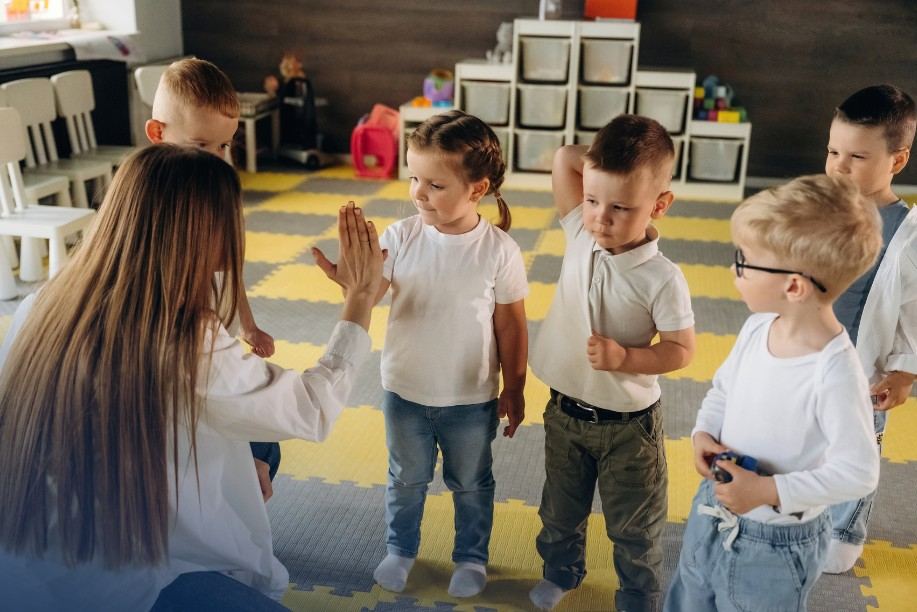
The child uses the same skill during a group game with peers.
Stage 3: Less Structured Interaction
The child practices during free play or another shared activity with fewer prompts.
Stage 4: New Environment
The child gets an opportunity to use the skill outside the therapy setting.
Stage 5: Everyday Use
The skill becomes part of everyday participation at:
- School
- Home
- A park
- A birthday party
- A recreational activity
The endpoint is not “the child performed the exercise correctly.”
The endpoint is functional social participation.
Research on early social communication interventions also shows why generalization matters. A systematic review examining 9 randomized controlled trials found that 8 studies showed at least some successful generalization across people, settings, or activities, although generalization was not consistent for every skill or situation.
What Can Social Skills Practice Look Like in Different Real-Life Settings?
Social skills become meaningful when children have opportunities to use them outside the original activity.
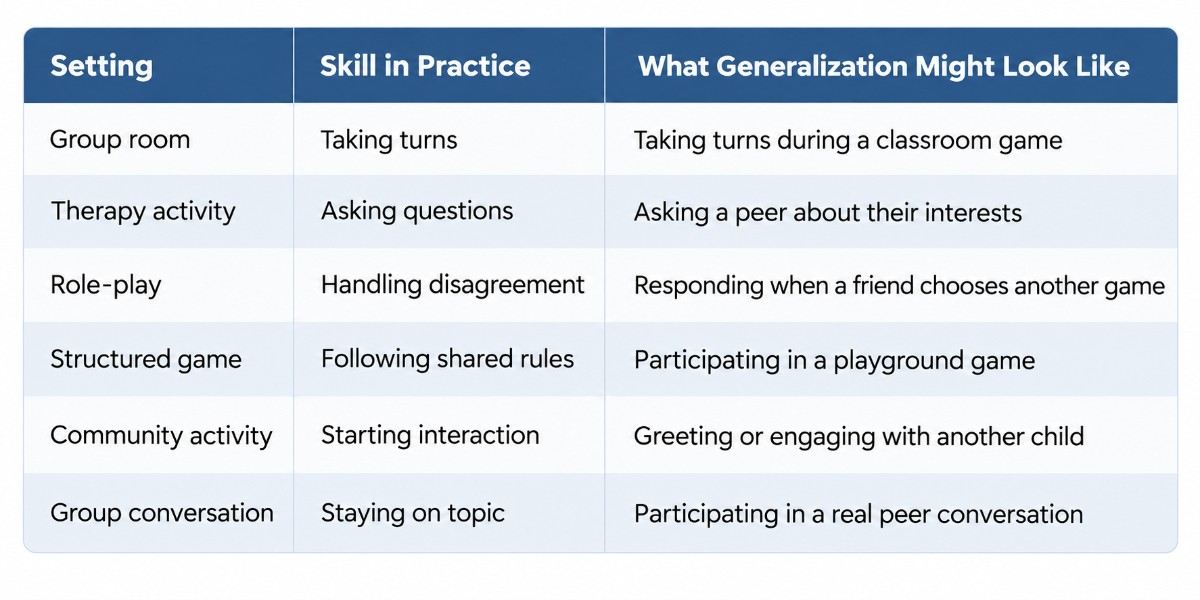
A Birthday Party Example
Say a child has practiced joining an activity in a social skills group.
Some kids have already started playing at a birthday party.
The real-world task may involve:
- Observing the actions of the other children
- Approaching the group
- Asking to join
- Responding to the answer
- Adjusting if the game changes
The real-world practice matters wholly because the situation is less predictable than a therapy activity.
Social skills are context-dependent.
That says a child may have the words to say in one situation, but needs support with figuring out what to do when the people, activity, and expectations change.
Role-Play Can Help, But It Isn’t the Finish Line
Role-play can be a useful teaching tool.
Children can use it to:
- Preview unfamiliar situations
- Practice language
- Explore possible responses
- Rehearse problem-solving
- Become familiar with a new situation
For example, a child can practice answering the question:
“What can you do if anyone refuses to play?”
That provides a starting point.
However, real dialogue may turn out to be something entirely different:
So I asked, and the other child said no. What do I do next?”
The child has to now respond to an incident that did happen.
Which is why you have a nice progression that goes:
Role-play → Facilitated practice → Natural opportunities
Although role-play can get a child ready for social situations, real people there to practice those skills will help link practice to day-to-day life.
Supporting Conversation, Turn-Taking and Friendship Skills
Conversation
Children may practice starting conversations, responding to others, asking follow-up questions, sharing information, and listening.
The goal should not be to force every child into the same conversational style. Instead, the focus can be on helping the child communicate and participate in ways that are meaningful for them.
Turn-Taking
Turn-taking can be practiced through:
- Board games
- Cooperative games
- Shared projects
- Group activities
These activities create natural opportunities to wait, respond, share, and follow shared rules.
Friendship
Social skills groups for autism can create opportunities to practice skills involved in building and maintaining peer relationships.
These may include:
- Finding shared interests
- Joining activities
- Maintaining interaction
- Handling differences
- Repairing misunderstandings
A group should not promise to “create friendships.” Instead, it can provide children with structured opportunities to practice skills that can support peer relationships.
Flexibility, Conflict and Emotional Awareness
Social interaction rarely follows a script.
Someone may change the rules. A child may lose a game. A friend may choose a different activity. A planned activity may suddenly change.
These situations can provide opportunities to practice:
- Waiting
- Hearing “no”
- Handling changes
- Choosing between activities
- Communicating needs
- Recognizing emotions
- Resolving disagreements
Bias is when two children want a different game to play.
Instead of teaching “Take Turns,” a group can facilitate them:
Punchline → Identify the Problem → Discuss → Contemplate → Come to a solution→ Keep Playing
This is much more analogous to what kids experience in real-life social problem-solving.
How Does Success On The Spectrum Build Social Skills Beyond the Group Room?
Social skills practice at Success On The Spectrum is structured to bridge the gap between the data you learn and places for implementation in real-world situations.
SOS centers may have specifically designed social spaces where children can practice targeted skills with their peers in a structured setting. Depending on the program and where you live, children may also have group settings, peer engagements, community excursions, and other situations in which they can practice skills for real-life or less-structured experiences.
The distinction is important.
Structured social practice creates a predictable setting where children can master and rehearse specific skills.
Community practice affords the chance to apply those skills in how and where it feels right rather than expected.
A useful framework is:
Practice the skill → Change the context → Change the people → Reduce support → Observe real-world use
For example, a child might first practice taking turns with familiar peers during a structured activity. Later, they may practice the same skill during a different game or community activity.
The exact opportunities available can vary by SOS location and the child’s individual program.
How Do You Know If Social Skills Are Generalizing?
A child doing well during a group session is encouraging. But parents can look beyond:
“My child did well in the group today.”
Ask whether the child can use the skill in different situations.
Can the Child…
- Use the skill with a different peer?
- Use it with less prompting?
- Use it during a new activity?
- Use it outside the therapy setting?
- Adjust when the situation changes?
- Apply the skill during spontaneous interaction?
- Use the skill at school or in the community?
A Generalization Check
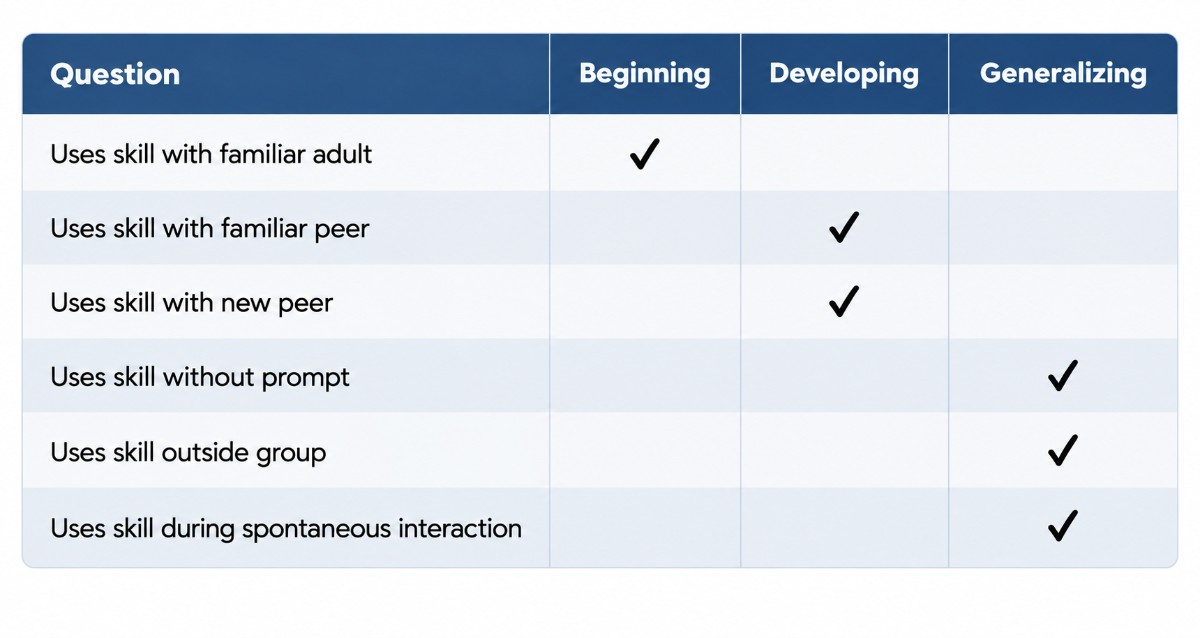
This is an educational framework, not a clinical assessment tool. Its purpose is to help families understand that social progress involves more than performing a skill during a structured session.
How Is Progress Measured in a Social Skills Group?
Progress should connect directly to the child’s individualized goals.
Depending on the goal, a treatment team may look at:
- Frequency of independent interactions
- Level of prompting
- Successful turn-taking
- Appropriate responses
- Conversation exchanges
- Ability to handle changes
- Participation duration
- Generalization across people and settings
Rather than writing “better social skills“, a team might collect data about whether the child initiates or accepts peer interaction with 1 prompt or fewer during a specific group activity.
The team might then see if a similar skill appears during less structured play, or within another setting.
Then the goal is to ascertain not just if a child learned the skill, but that they can apply it meaningfully.
The Bottom Line: Social Skills Need Somewhere to Go
A child can practice a social skill correctly in a structured setting and still need support using it in everyday life.
That is why meaningful social skills programming should move beyond:
Teaching → Practice
toward:
Teaching → Peer Practice → New Contexts → Community → Independent Use
The goal is not simply a successful group session. It is helping children participate more meaningfully with other people where real life happens.
Explore Social Skills Classes at Success On The Spectrum
As a component of our customized autism services, Success On The Spectrum offers children the chance to work on social interaction and communication, flexibility, and peer participation in a structured environment.
If you are exploring social skills support for your child, check out the programs offered at your local SOS center and how social goals can be integrated into your child’s greater treatment vision.
Explore Autism Therapy at SOS and Find Our Nearest Center
FAQs
There is no single age that works for every child. The right time depends on the child's developmental level, communication abilities, social needs, and individual goals. A provider can help determine whether a group setting is appropriate.
Look for a program that uses individualized goals, provides opportunities for peer interaction, tracks progress, and considers how skills will be used outside the group. It is also important to understand how the program supports generalization.
Social participation does not depend on spoken language alone. Children may communicate using speech, gestures, signs, pictures, AAC, or other methods. Social goals should reflect the child's individual communication abilities and needs.
Parents can create natural opportunities to practice skills during play, family routines, recreational activities, and community outings. Ask the treatment team which skills are currently being targeted and how you can support them in everyday situations.
Start by understanding why. The child may need a different activity, additional support, a smaller group, or a different way to participate. A social skills program should consider the child's individual needs rather than assuming every group activity will work for every child.

Nichole Daher is an American entrepreneur, book author, autism advocate, and founder of Success On The Spectrum (SOS)-the first autism treatment franchise in the United States-known for its parent viewing rooms and quality-driven ABA services.