

Summary
Pediatric occupational therapy for kids with autism focuses on helping children use everyday skills across home, school, play, and community settings. It can support self-care, dressing, feeding, handwriting, fine-motor skills, sensory needs, routines, transitions, coordination, and independence. The article explains how OT goals should connect to meaningful daily activities and how parents can support skill carryover beyond the therapy setting.
“OT happens in a therapy room, so why does it matter what happens at home or school?”
This is why it actually matters. Your kid’s not practicing skills just to practice them in a therapy room. They’re learning to get dressed on a Tuesday morning. To eat breakfast without you doing it for them. To write something down in class. To play with other kids. To follow the routine without you reminding them fifty times. To be more independent.
And here’s what trips people up. Your kid might nail buttoning a shirt during therapy. The therapist shows you, and it’s perfect. But then it’s a school morning. You’re running late, your kid’s tired, they’re wearing a different shirt, and suddenly it’s impossible. The skill’s there. But actually using it when it’s real and messy and rushed? That’s a different story.
That is why real OT doesn’t just lock in on one skill. It looks at your kid’s actual life.
- What does your morning look like?
- What’s happening at school?
- How does your kid play?
- What’s hard in your house?
- What goes down when you’re at the grocery store?
Occupational therapy for kids thinks about all of it.
A helpful way to think about it is:
Home → School → Play & Community
These three places all ask your kid to use skills in different ways. Something that works in a quiet therapy room isn’t going to work in a loud classroom. Won’t work on a playground packed with kids. Won’t work at the store when it’s crazy. So the approach has to shift depending on where your kid is.
What Does Pediatric Occupational Therapy Work On?
OT helps your kid build the skills they need to actually do everyday stuff. Depending on what’s going on with your kid, that could be:
- Hand strength and coordination
- Eye and hand working together
- Larger body movements
- Figuring out how to move their body
- Getting dressed and bathing
- Eating
- Handling different textures and sensations
- Being part of a classroom
- Playing
- Managing a routine
- Doing things without you doing it for them
OT does not only ask, “Can your kid do this?”
It also asks, “Can your kid actually pull this off when they need to?”
That difference is huge. A lot of people think occupational therapy for kids is just about whether they can perform something. But that’s not even close to what matters. A skill only counts if your kid can actually use it. At breakfast. In a classroom. On the playground. With their family. That’s where the real work happens.
The Three-Environment Framework
Children move through different environments every day, and each one brings its own challenges.
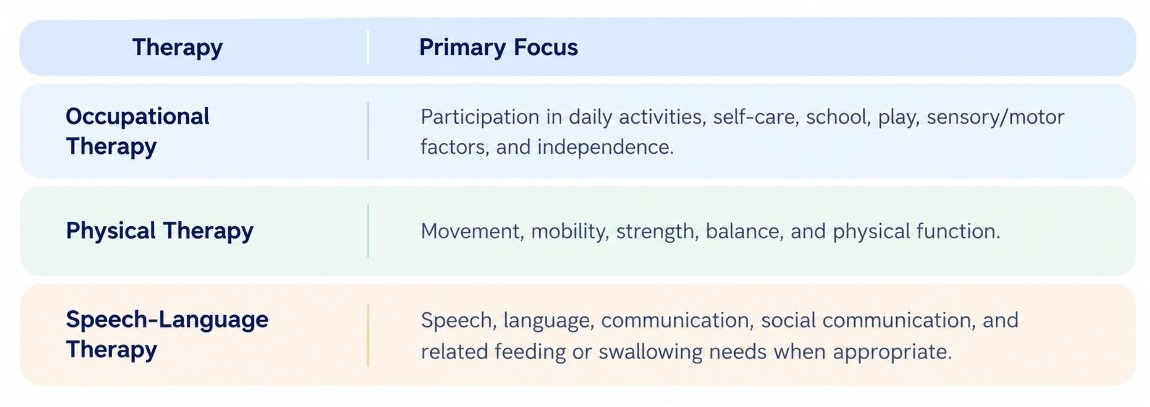
A child may be comfortable completing an activity in one environment and struggle with the same activity somewhere else.
For example, a child may follow a three-step activity when the therapist gives clear instructions in a quiet room. At school, however, the same child may struggle because there is more noise, movement, and distraction.
OT looks at those differences instead of assuming that one environment represents the whole picture.
Pediatric OT at Home: Building Everyday Independence
Home is where you start noticing stuff. Your kid does the same things every single day. Getting dressed. Brushing teeth. Eating. Bathing. So it’s pretty easy to see what’s actually hard for them.
Dressing and Getting Ready
Getting dressed is way more complicated than it sounds.
Your kid needs to:
- Find clothes that are actually wearable
- Figure out which way things go
- Get socks and shoes on
- Deal with buttons or zippers
- Do it in the right order
- Get through it without you telling them every single step
Here’s the thing though. Your kid might be able to put on a shirt when you’re standing there giving instructions one at a time. Slow, controlled, quiet. But then it’s a school morning. You’re yelling that the bus is in five minutes. Your kid freezes. Can’t remember what comes next. Give up.
An OT looks at a bunch of stuff. Your kid’s hands and coordination. Whether they can remember the order. Whether certain textures bug them. Whether they need a picture to follow along. How much you have to tell them to keep going.
The goal isn’t just “put on a shirt.”
The real goal is your kid actually getting dressed during a real morning without you having to do the whole thing.
Feeding and Mealtime Participation
Eating involves a lot. Sitting without sliding around. Using a fork or spoon. Drinking from a cup. Opening packages. Following what happens at meals. And sometimes food itself is the problem. Certain textures weird your kid out. Smells bother them. Certain foods feel wrong in their mouth.
If eating’s an issue, it has to be based on what’s actually going on with your specific kid. You don’t have to force your kid to eat things they hate. That just makes mealtimes miserable.
Hygiene and Self-Care
OT can help with everyday self-care stuff like:
- Brushing teeth
- Washing hands
- Taking a bath
- Grooming
- Using the toilet
Sometimes the issue is just that your kid’s hands aren’t strong enough or coordinated enough. Other times they can physically do it, but they can’t remember the order, or they get stuck between steps.
Breaking things into smaller chunks or using pictures to show what comes next makes it way easier.
Home Routines
OT looks at other stuff too, like bedtime routine, cleaning up toys, and putting things away. Moving from one activity to the next without melting down. Helping out with simple family stuff.
Home carryover isn’t extra work for you. It’s where skills stop being therapy exercises and become part of actual life.
Pediatric OT at School: Supporting Classroom Participation
School occupational therapy for kids is way bigger than just handwriting.
A classroom is a lot. Your kid has to manage materials, follow the routine, switch between activities, and do hands-on stuff. It’s not like home, where most things are predictable.
Handwriting and Fine-Motor Tasks
OT might work on:
- How your kid holds a pencil
- How long they can write before their hand gets tired
- Cutting with scissors
- Coloring
- Using classroom tools
- Opening containers
But here’s the real thing. Your kid doesn’t need better pencil control just to hold a pencil better. They need it so they can actually do their schoolwork. So they can keep up in class. So they’re not frustrated every time they have to write something down.
Classroom Routines
OT also looks at how your kid handles:
- Classroom materials
- Moving between activities
- Following the routine
- Managing their stuff
- Hands-on learning
- Self-care tasks
Your kid might be able to do an activity. They might be great at it. But switching to the next thing? That could be where they fall apart. So OT works on that transition piece too.
Sensory and Environmental Demands
Classrooms are hectic. There’s noise in the background. Kids moving around. Bright lights. Crowded hallways. Random changes. Sometimes all of that is what’s actually making it hard for your kid to function.
An OT looks at whether the classroom itself is the problem. Whether there’s something that could help. Maybe your kid needs a quieter spot. Maybe a visual schedule helps. Maybe a sensory break makes a difference.
The goal isn’t to make the classroom perfect and quiet for your kid. It’s to help your kid actually participate in a regular, busy classroom without shutting down.
A Simple Example
In therapy: A child practices cutting along simple lines.
At school: The child uses that skill during an art project.
The meaningful progress: The child can take part in the classroom activity with less assistance.
That’s the difference between practicing a skill and using a skill.
Pediatric OT Through Play and Community Activities
Play is an important part of childhood. It gives children opportunities to move, explore, solve problems, use their imagination, and interact with other people.
Playground Skills
An OT may address skills related to:
- Balance
- Coordination
- Motor planning
- Navigating playground equipment
- Confidence with movement
Games and Peer Play
Depending on the child’s needs, OT may also support taking turns, using game materials, following a simple game routine, or being flexible when play doesn’t go exactly as expected.
OT does not replace speech therapy or dedicated social-communication services. Instead, it can complement those services when motor, sensory, or functional skills affect a child’s ability to participate in play.
Community Participation
Everyday community activities provide another opportunity to use skills.
This might include:
- Going to a park
- Visiting a store
- Participating in recreation
- Attending family events
- Trying a new activity
A child may need to use the same underlying skills in very different environments.
For example, a child may practice following a three-step movement sequence during OT. Later, they may use sequencing and coordination while entering a playground, choosing equipment, completing an activity, and moving to the next one.
The goal isn’t to recreate the therapy exercise. It’s to use the underlying skill in a meaningful situation.
Where Do Sensory Needs Fit In?
Sensory differences can affect participation at home, school, and in the community.
At home, a child may struggle with clothing, bathing, mealtimes, or household sounds.
At school, noise, crowded transitions, lighting, movement, or unexpected touch may make participation harder.
In the community, stores, restaurants, parks, and family events can introduce unfamiliar sensory experiences.
The most useful question isn’t:
“How do we eliminate every sensory response?”
It’s:
“How are sensory needs affecting this child’s everyday life?”
An OT can consider the child’s individual needs and identify appropriate strategies, environmental changes, adaptations, or routines that may support participation.
What Do Functional OT Goals Look Like?
One of the easiest ways to understand functional OT is to compare a general skill goal with what that skill is actually helping a child do.
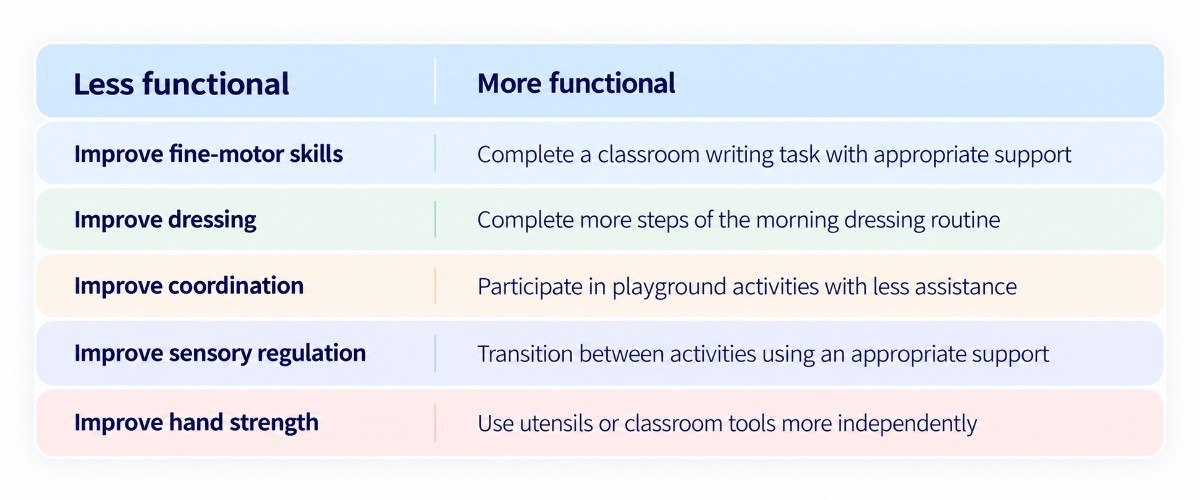
The right goal depends on the child. A therapist may identify a particular skill that needs work, but the reason for working on it should connect back to the child’s everyday life.
How Do Skills Generalize Outside the Clinic?
Clinic skill ≠ finished skill.
A child may learn a skill during therapy but still needs support using it at home, school, or in the community.
Consider a few examples:
Dressing
Therapy: Practice buttons and zippers.
Home: Use those skills while getting ready for school.
Handwriting
Therapy: Practice visual-motor and pencil-control skills.
School: Apply those skills during actual classroom work.
Motor Planning
Therapy: Complete a movement sequence.
Playground: Use coordination and sequencing during play.
Transitions
Therapy: Practice a predictable transition strategy.
Community: Use the strategy when changing activities during an outing.
This is why parents can ask an important question:
“Where will my child need this skill next?”
SOS takes a broader approach to helping children apply skills beyond a single therapy setting, including opportunities for community experiences and parent involvement. The purpose is to help skills become useful in everyday situations.
How Can Parents Support OT Goals at Home?
Parents don’t need to become their child’s therapist.
The most helpful support is often simple and consistent:
- Practice skills during routines you already have.
- Give your child opportunities to try things independently.
- Use visual supports or strategies recommended by the OT.
- Avoid automatically doing every step for your child.
- Tell the therapist what works at home.
- Share when a strategy isn’t working.
- Practice skills in different everyday situations.
The goal is carryover, not turning your home into another therapy room.
How Is Pediatric OT Progress Measured?
Progress isn’t always about doing something perfectly.
It might mean:
- Completing more steps independently
- Needing fewer prompts
- Participating for longer
- Completing a task more consistently
- Needing less assistance
- Using a skill in another environment
- Handling everyday routines more successfully
For example, instead of only asking:
“Can the child button a shirt?”
a therapist and parent may look at:
“Can the child complete more of the dressing routine independently on school mornings?”
That second question tells us much more about how the skill is helping the child in real life.
Questions Parents Commonly Ask About Pediatric OT
Does my child need a diagnosis to receive OT?
It depends on where you’re getting services and what’s available to your family. But here’s the thing: if your kid’s struggling with everyday stuff, you don’t need a label to talk to a pediatrician or an OT about it. Just bring up what you’re noticing.
Is OT only for children with autism?
Nope. OT helps kids with all kinds of things. Physical stuff, sensory stuff, learning differences, coordination issues, developmental delays. All over the place.
Does OT happen only in a clinic?
Not at all. It might happen at your house, at school, at the park, or in a therapy office. Depends on what your kid needs and what kind of services you’re using.
How long does a child need OT?
There’s no set answer. Some kids need a few months, some need years. It’s totally dependent on where your kid’s starting from, what you’re working on, how fast they progress, and what’s actually available.
Can OT work with other therapies?
Absolutely. OT works alongside speech therapy, ABA, physical therapy, tutoring, special education support, whatever else your kid needs. They all work together.
The Bottom Line: OT Should Follow the Child Into Real Life
Here’s what matters: therapy doesn’t just happen in the therapy room. It has to actually work in your kid’s real world.
At home, the real question is: Can your kid actually handle getting ready, eating, bathing, doing what they need to do?
At school, it’s: Can your kid sit in class, do the work, be around other kids, participate?
Out in the world, it’s: Can your kid use the stuff they’re learning to actually do things they care about?
Good OT doesn’t treat home, school, and real life as separate things. It all connects. The goal isn’t your kid being amazing at exercises during therapy. It’s your kid being able to handle their actual day with more confidence and independence.
Explore Pediatric Occupational Therapy at SOS
If your kid’s having a rough time with getting dressed, schoolwork, hand coordination, sensory stuff, playing, or daily routines, talking to an OT might help figure out what’s actually going on.
At Success On The Spectrum, OT is part of a whole package. You get OT, ABA, speech therapy, parent coaching, and social skills support. Everything’s coordinated so your kid’s getting consistent help everywhere.
FAQs
If your kid's regularly struggling with getting dressed, eating, grooming, writing, playing, following routines, or handling certain places, that's worth talking to an OT about. They can help figure out if it's an OT thing or something else.
The therapist will ask you about your kid's routines and what's been tough. They'll watch your kid do things. They might do some formal testing. The whole point is understanding what your kid's good at and where they're stuck so you can set goals that actually make sense.
If your kid loves drawing or building or running around or playing games, an OT uses that. They build the skills your kid needs to practice into the stuff your kid already enjoys. Makes it way less like therapy and more like actually doing something fun.
Everything. A noisy room makes things harder. Too many people around is overwhelming. The materials available matter. The routine matters. Expectations matter. A good OT looks at all that and figures out how to make the environment work better for your kid instead of just working on the kid in isolation.
As your kid changes, the goals change. When they master something, you shift to using it in new ways or in different places. When you notice something new is a problem, that becomes the focus. It's not static. It evolves as your kid evolves.

Nichole Daher is an American entrepreneur, book author, autism advocate, and founder of Success On The Spectrum (SOS)-the first autism treatment franchise in the United States-known for its parent viewing rooms and quality-driven ABA services.