


Summary
Occupational activities for autistic children should correspond to their personal functional demands. Do not pick an activity out randomly, but instead identify the skill and then choose an activity to practice with intention, tailoring it to actual life experience as appropriate. You can assist people with fine-motor, sensory, coordination, self-care, regulation, and learning to play and participate independently through OT.
When choosing occupational therapy activities for kids, the goal isn’t to pick from a long list. It’s to identify the everyday skill a child needs to practice.
For example:
- Play dough: hand strength and manipulation
- Buttoning: dressing independence
- Blocks: visual-motor skills and coordination
- Obstacle courses: motor planning and sequencing
- Sensory activities: participation in challenging routines
SOS pediatric OT can help children with fine-motor, visual-motor, sensory-motor, self-help, balance, strength, coordination, organization, and self-regulation. However, it is not just about participating in an activity. It is meaningful participation at all ages and ability levels at home, school, and in the community.
This focus on functions matches the practice of occupational therapy activities for kids, where using activities that cultivate skills and participation in meaningful occupations is part of our approach.
Start With the Skill, Not the Activity
A common mistake is choosing an activity first and trying to find a reason for it afterward.
Instead, start with the functional target.
1. Identify the Functional Target
What does the child need to do?
Maybe they struggle with dressing, holding a pencil, using utensils, joining play, or completing a multi-step routine.
2. Choose the Activity
What activity provides an appropriate opportunity to practice that skill?
3. Grade the Challenge
How can the activity be made easier or harder so it is challenging without becoming overwhelming?
4. Connect It to Real Life
Where will the child use this skill outside therapy?
This is an important part of our occupational therapy. Activities should have a clear connection to what a child needs or wants to do in everyday life.
The Skill-to-Activity Matrix
The following matrix can give parents a starting point. The right activity and level of difficulty should still be based on the child’s individual needs and, when appropriate, guidance from an occupational therapist.
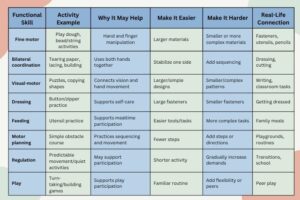
The key is not to assume that every child needs every activity. An occupational therapy activity for kids can help determine which skills are affecting participation and how activities should be adapted.
Fine-Motor Activities: Build Skills for Hands-On Tasks
Fine-motor activities can be useful when they connect to something the child needs to do.
Activity examples:
- Play dough manipulation
- Picking up objects with tongs
- Sticker activities
- Lacing cards
- Simple crafts
- Building with blocks
- Opening and closing containers
These occupational therapy activities for kids may support skills used for:
- Using utensils
- Managing buttons and zippers
- Holding writing tools
- Manipulating classroom materials
- Playing with toys
How to Grade the Activity
Easier: Use larger objects, fewer steps, and shorter activity periods.
Harder: Use smaller materials, more precise movements, or longer sequences.
It’s not about making fine-motor tasks harder just for the sake of difficulty. The objective is to build a child’s ability so that he/she becomes successful and can thrive on his/her own.
Bilateral Coordination: Help Both Hands Work Together
Bilateral coordination involves using both sides of the body together when completing a task.
Kids utilize this further, for example, being allowed to wear clothing, slice food materials, and open holders or containers.
Activities may include:
- Lacing
- Tearing paper
- Opening containers
- Building with construction materials
- Rolling and shaping play dough
- Cutting paper while stabilizing it with the other hand
Real-Life Connections
The same underlying coordination may be useful for:
- Cutting food
- Opening packages
- Getting dressed
- Using school materials
- Completing crafts
Grade the Activity
Easier: Use larger materials or provide stabilization.
Harder: Add sequencing, precision, or multiple steps.
The activity should remain manageable enough that the child can participate successfully.
Visual-Motor Activities: Connect What the Eyes See With What the Hands Do
Visual-motor skills involve using visual information to guide hand movements.
Activities may include:
- Puzzles
- Copying simple designs
- Connecting dots
- Drawing
- Simple mazes
- Block patterns
- Matching activities
These skills can support:
- Handwriting
- Copying
- Cutting
- Building
- Classroom activities
- Other visual tasks
A Parent Example
A child will know how to hold a pencil but may not copy a shape properly.
That does not mean the issue is just pencil-holding problems.
Whereas an OT may have a broader focus on visual-motor coordination, attention & positioning, the task itself, and the classroom demands surrounding writing.
What is preventing participation, and what do we wish to understand?
Dressing Activities: Practice the Routine, Not Just the Fastener
Button boards and zipper practice are common OT activities, but dressing involves much more than fastening clothing.
It may require:
Sequencing + coordination + motor planning + sensory tolerance + attention + independence
Activities may include:
- Button boards
- Zipper practice
- Dressing dolls
- Putting on and removing simple clothing
- Practicing socks and shoes
How to Grade the Activity
Easier: Use larger buttons, loose clothing, or fewer steps.
Harder: Use smaller fasteners, add more steps, or reduce adult assistance.
The functional goal is bigger than:
“Can the child button this?”
It is:
“Can the child participate in getting dressed?”
That difference is at the heart of a function-focused OT approach.
Feeding Activities: Keep the Focus on Functional Participation
Feeding activities should also have a clear purpose.
Possible activities can include:
- Utensil practice
- Scooping
- Pouring
- Opening containers
- Practicing cup use
- Food preparation tasks
If sensory differences are a part of the feeding concern, parents do not want to assume that any and every selective eating behavior should be treated with exposure via forced exposure.
Feeding difficulties can be sensory, motor, behavioral, medical, and more. You may consider a more individualized assessment if there are ongoing concerns or they impede participation, nutrition, safety, or family routines.
Functional Goal
The goal is participation in mealtimes, rather than simply completing an isolated feeding exercise.
Safety note: Children with known swallowing or choking concerns should receive appropriate professional guidance before parents introduce feeding activities intended to address those concerns.
Motor Planning Activities: Practice “What Comes Next?”
Motor planning involves figuring out and organizing the movements needed to complete an activity.
A simple obstacle course can turn this into a playful challenge.
Example:
Step 1: Crawl through a tunnel
Step 2: Pick up a ball
Step 3: Walk to a target
Step 4: Throw the ball
Other activities may include:
- Follow-the-movement games
- Multi-step building activities
- Pretend-play routines
- “First this, then that” movement sequences
Grade the Activity
Easier: Use fewer steps and demonstrate each movement.
Harder: Add steps, reduce prompting, or change the environment.
The same skill may eventually be useful during playground activities, daily routines, classroom transitions, and other multi-step tasks.
Sensory Regulation Activities: Match the Environment to the Child
Sensory activities should not become a generic list of sensory toys.
The more useful question is:
What sensory or environmental demands are affecting participation?
Depending on the child’s needs and goals, an OT may consider:
- Quiet movement
- Structured movement activities
- Calming movement routines
- Tactile activities
- Reduced-distraction environments
- Predictable movement breaks
Key Principle
The goal isn’t to make every sensory response disappear.
The goal is to help the child participate more successfully.
For example, a child may become overwhelmed during a busy transition. Instead of simply handing the child a sensory toy, it may be useful to consider:
Environment → timing → predictability → movement → communication → recovery
That broader view can reveal more opportunities to support participation.
Play Activities: Use What the Child Already Enjoys
Play can provide a natural setting for practicing skills because it is already meaningful to children.
Activities may include:
- Building
- Pretend play
- Art
- Games
- Puzzles
- Movement play
An OT can adapt play to work on:
- Fine-motor skills
- Coordination
- Motor planning
- Visual-motor skills
- Social participation
- Flexibility
Play is an original and valid occupation of childhood, and occupational therapy can facilitate participation through the child’s preferred interests and characteristics.
For an autistic child, pursuing their interests can also help make the activity more engaging. For instance, a popular building activity could include moments where the child can practice coordination, planning, turn-taking, and flexibility without it feeling like a worksheet or drill.
How to Grade an OT Activity: Make It “Just Right”
An activity can be:
- Too easy
- Too difficult
- Just right
The goal is not automatically to make an activity harder.
The goal is to find an appropriate challenge that allows the child to participate, practice, and build confidence.
6 Ways to Adjust Difficulty
- Change the size
Large materials → smaller materials
- Change the number of steps
One step → multi-step sequence
- Change the amount of support
Full assistance → verbal cue → greater independence
- Change the environment
Quiet setting → more natural environment
- Change the time
Short activity → longer participation
- Change the complexity
Simple pattern → more complex pattern
AOTA describes this type of activity selection and adaptation as part of occupational therapy intervention, with activities chosen to support performance skills and meaningful occupations.
Safety: When an OT Activity Shouldn’t Be DIY
Online activity ideas can be useful for inspiration, but they are not a substitute for an individualized OT evaluation.
Parents should seek professional guidance when:
- A child has swallowing or significant feeding concerns.
- An activity involves a significant fall risk.
- A medical or physical condition affects movement.
- Sensory activities consistently cause distress.
- A child has difficulty recovering after an activity.
- Equipment is involved, and the parent is not confident using it.
- Functional difficulties are persistent or significantly interfere with daily life.
The activity that works well for one child may not be appropriate for another.
How Do You Know an Activity Is Helping?
Completing an activity is not necessarily the same as making progress.
Instead of asking:
“Did my child finish it?”
Ask:
- Is my child becoming more independent?
- Is the task becoming easier?
- Are fewer prompts needed?
- Is participation increasing?
- Is the skill appearing in another setting?
- Is frustration decreasing?
- Can my child use the skill during a real routine?
For example, if a child practices buttoning during therapy, the meaningful outcome may be whether they eventually need less help getting dressed at home.
This is why OT focuses on meaningful activities and participation rather than isolated performance alone.
The Takeaway: Choose Activities With a Purpose
Not every complex OT activity is the best one.
It is the one that fits with what the child needs.
Use this framework:
Pinpoint the skill → select an intentional action → modulate the level of challenge → relate it to quotidian life → track function.
It is not about doing as many OT activities.
To help a child use the skills in an appropriate way.
- Independence
- Participation
- Confidence
- Safety
- Consistency
For some children, that could mean being able to put on their clothes with less assistance, joining meal times, getting to things within the classroom, joining in with play, managing transitions, or even participating in day-to-day routines with more success.
Need Help Choosing the Right OT Activities?
Our individualized pediatric OT evaluation can determine skills and activity preferences to recommend goals or strategies if you are uncertain which activities meet whole-body challenges related to fine-motor, sensory, self-care, coordination, or participation.
Explore Pediatric Occupational Therapy at SOS Near You
The types of functional areas that pediatric OT can address at Success On The Spectrum include: fine-motor, visual-motor, sensory-motor, self-help, organizational, balance, strength, and coordination skills as well as self-regulation.
FAQs
There is no single schedule that works for every child. Home activities should fit the child's goals, abilities, attention, and daily routine. An OT can recommend appropriate activities and frequency based on the child's individual needs.
They can absolutely be part of everyday play. Building, drawing, dressing, games, crafts, and movement activities can all provide opportunities to practice functional skills when they are selected with a clear purpose.
Refusal can be useful information. The activity may be too difficult, too long, unfamiliar, or poorly matched to the child's interests or sensory needs. An OT can help identify ways to adjust the activity rather than simply expecting the child to push through it.
Yes. Depending on the child's needs, OT may address skills related to handwriting, cutting, classroom materials, visual-motor coordination, organization, transitions, and participation in school routines.
There is no universal timeline. Progress depends on the child's needs, goals, consistency, environment, and other factors. Meaningful progress may show up as greater independence, fewer prompts, improved participation, or better use of a skill across everyday settings.

Nichole Daher is an American entrepreneur, book author, autism advocate, and founder of Success On The Spectrum (SOS)-the first autism treatment franchise in the United States-known for its parent viewing rooms and quality-driven ABA services.