

Summary
High-quality ABA therapy should be individualized, functional, measurable, and supervised by qualified professionals. Programs should prioritize communication, independence, daily living, social participation, and real-world skill generalization. Parents should be actively involved, progress should guide treatment decisions, and goals should adapt to each child’s needs. Families should evaluate providers beyond therapy hours or amenities.
When every program provides seemingly the same promise, selecting an ABA provider can be overwhelming. Many hours of therapy, amenities, seasoned staff members, and a long list of services offered can surely entice one’s interest. But these particulars do not tell you whether such a program is the best fit for your child.
Instead, focus on the structure and delivery of the program.
So a robust ABA program will answer up front a couple of key questions.
- For whom is this plan designed?
- What actual skills will my child gain?
- How is progress measured?
- Who supervises treatment?
- Will these skills translate out of therapy?
- How are parents involved?
ABA, Applied Behavior Analysis, is a targeted treatment approach that might promote skills like communication, learning, daily living, social abilities, and independence or other meaningful skills guided by the child’s assessment of strengths and needs in relation to specific goals.
A 2023 meta-analysis identified small to medium effects from comprehensive ABA-based interventions for both intellectual functioning and adaptive behavior, compared with usual, minimal, or no treatment. But it was less clear that there were additional benefits in a child’s language ability, severity of autism symptoms, or parental stress.
What Should ABA Therapy for Kids Actually Address?
ABA therapy for kids should never be a one-size-fits-all program.
Two children may have the same autism diagnosis but differ in strengths, challenges, communication styles, and goals. ABA can address the following depending on the child’s assessment:
- Functional communication
- Learning skills
- Daily living and self-care
- Independence
- Social participation
- Play
- Routines and transitions
- Safety skills
- School participation
- Community participation
The diagnosis is not the treatment plan
They should ask which of their child’s needs are unmet and what those unmet needs translate into goal-related concerns. Autism describes ABA as an individualized method of teaching skills and promoting independence.
Are the Goals Truly Individualized?
One of the first questions to ask an ABA provider is:
“How did you choose my child’s goals?”
A good program should be able to explain:
- What the assessment identified
- Your child’s current strengths
- Which skills are priorities and why
- How each goal will be measured
- How the team will know when a skill is mastered
Compare:
Weak Goal: “Improve social skills.”
Strong Goal: “Engage in a structured turn-taking activity with a peer using an appropriate communication strategy.
The second one is specific, measurable, functional, and is easier to evaluate.
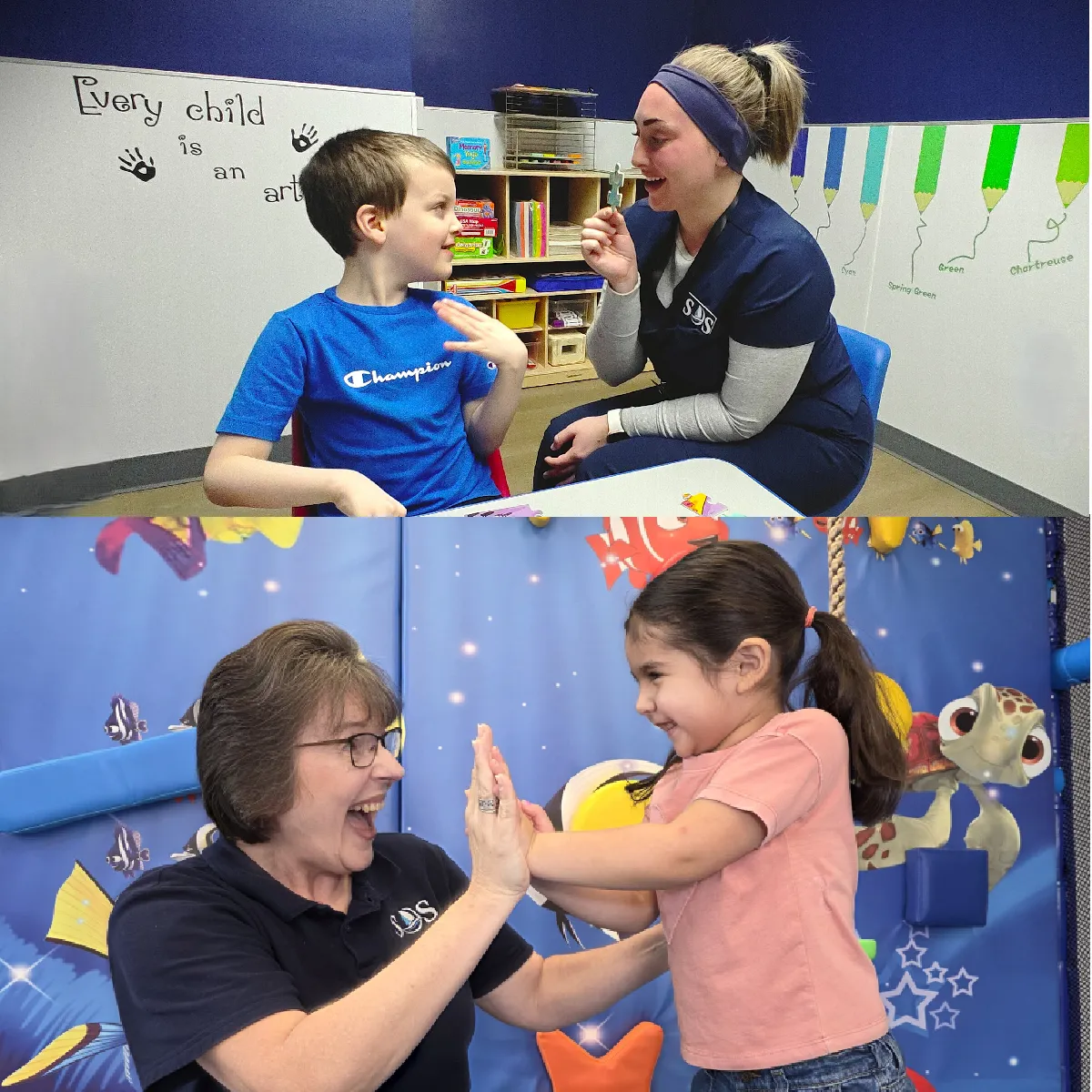
Individualized ABA at Success On The Spectrum (SOS) focuses on every child’s needs and aims to enhance communication, independence, and adaptive behavior.
Communication Should Be a Core Priority
Communication is beyond speaking.
A child expresses independently via speech, gesture, sign, picture, or AAC. An effective ABA program should be facilitative of the child’s most appropriate method for using communication.
Communication goals may include:
- Requesting
- Rejecting
- Asking for help
- Making choices
- Commenting
- Responding
- Functional conversation
- Communicating during everyday routines
- Using AAC when appropriate
The intention is not to just create more words. The intention is for the child to be able to communicate better and do more things on his own.
ABA may also be used in conjunction with speech therapy if indicated. Speech therapy is another one of the autism services SOS provides.
Independence Should Matter More Than Compliance
Complying with instructions can be a skill, but being able to comply should never be the behavior used to measure progress.
Ask what a skill enables your child to do.
Instead of focusing only on:
“Sitting quietly.”
Consider:
“Engaging in a classroom task with the necessary support.”
Instead of:
“Following commands.”
Consider:
“Becoming more independent in this important daily task.”
In the same way, just because repetitive behavior appears graphically different from stereotypic or rhythmic movement, it should not be targeted automatically. It is helpful to ask if the behavior disrupts safety, communication, learning, comfort, or participation.
Good quality ABA, more accurately, should support children in accessing purposeful activities and growing independent.
How Does an ABA Program Measure Progress?
Data is an important part of ABA, but collecting data is only useful when it helps the team make better treatment decisions.
Parents should know:
- What is being measured?
- How often is it measured?
- Who reviews the data?
- When are goals reviewed?
- What happens if progress slows?
- How is mastery determined?
Progress might include:
- More independent responses
- Fewer prompts
- Greater communication
- Better participation in daily routines
- More consistent skill use
- Less adult assistance
Data should drive decisions, not simply document sessions.
If progress stalls, the team should be willing to reconsider the goal, teaching strategy, level of support, or environment.
Does the Skill Work Outside the Therapy Room?
The process for learning a skill in a structured format is only one component.
The real question is:
The question: “Can my child use this skill in daily life?
For example:
Clinic: Rather, a child learns how to ask for help.
Greater than Home: The child pleads for assistance while pulling on clothes or unsealing a package.
Clinic: A child practices transitions.
School: You employ the child with similar techniques whilst transitioning from one movement to another.
A child practices social interaction at a clinic.
Community: The child draws on those skills in an off-school setting
It is called generalization, and it should be a key component of an ABA program.
SOS promotes Natural Learning Opportunities with community-based experiences and opportunities for children to practice their skills outside the therapy room.
When comparing providers, ask:
“Whereafter my child learns the skill, will he/she be using it?
Should Parents Be Involved?
Parents should not be merely passive audiences for sporadic updates on their child’s progress.
What parents should get from a strong ABA program:
- What their child is learning
- Why each goal matters
- What strategies are being used
- How progress is measured
- Working on carryover at home
This can include communication, routines, prompting, reinforcement, generalization, and independence.
No one is asking parents to play therapist. We have a target for consistent support and skill generalization, not to make home just another clinic.
SOS also has a heavy focus on parent involvement and transparency. It has Parent Viewing Rooms that allow parents to view their child during therapy via live camera feeds, giving families higher transparency into what happens in treatment.
Does the Program Practice Skills in Real-World Settings?
Ask whether therapy prepares your child for the places they actually live, learn, and play.
Home
- Self-care
- Family routines
- Mealtimes
- Daily responsibilities
School
- Classroom routines
- Transitions
- Learning activities
- Peer participation
Community
- Safety
- Communication
- Waiting
- Social interaction
- Flexibility
SOS incorporates real-world and community-based experiences to help children practice skills beyond the center. This supports the idea that therapy should prepare children for life, not just therapy sessions.
Who Supervises the ABA Program?
Parents should understand who is responsible for clinical decisions.
Ask:
- Who develops the treatment plan?
- Who supervises the team?
- How frequently does supervision occur?
- Does the BCBA observe my child in person?
- Who reviews the data?
- How are treatment decisions made?
- What happens when progress stalls?
Having a BCBA involved does not automatically guarantee quality. The important question is how actively qualified clinical supervision shapes your child’s treatment.
SOS emphasizes in-person BCBA oversight, giving families direct access to clinical supervision within its centers.
How Does ABA Work With Other Services?
Children may receive ABA alongside speech therapy, occupational therapy, school-based services, or other supports.
These services should work toward the child’s broader functional needs rather than becoming disconnected treatment plans.
For example, a child working on independent mealtimes may receive:
- OT: Support for relevant motor and self-care skills.
- Speech: Communication support when appropriate.
- ABA: Support for learning, routines, independence, and generalization.
SOS offers ABA, speech therapy, and occupational therapy, allowing families to explore multiple services based on their child’s needs.
Red Flags When Comparing ABA Providers
A red flag does not automatically mean a provider is poor, but it should lead to more questions.
Look more closely if a provider:
- Uses essentially the same goals for every child.
- Cannot explain why a goal was selected.
- Focuses heavily on compliance without explaining its purpose.
- Cannot explain how progress is measured.
- Rarely reviews or adjusts goals.
- Offers little caregiver involvement.
- Cannot explain how skills generalize outside the clinic.
- Makes broad promises about changing autism itself.
- Cannot clearly explain who supervises treatment.
- Avoids reasonable questions about your child’s care.
The 10-Point ABA Provider Comparison Checklist
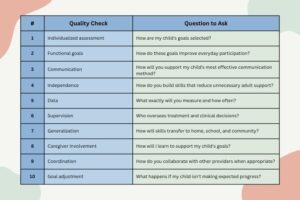
Use this checklist when comparing providers. Ask each provider the same questions and compare the answers, not just the marketing.
You can score each answer:
0 = No clear answer
1 = Somewhat clear
2 = Strong, specific answer
16–20: Strong answers worth exploring further
10–15: Ask follow-up questions
0–9: Investigate carefully before choosing
This is an informational comparison tool, not a clinical rating system.
Questions to Ask During an ABA Provider Tour
A provider’s willingness to answer these questions clearly can tell you a lot about its approach.
How Success On The Spectrum Approaches ABA Therapy
At Success On The Spectrum, ABA is around the individual child as opposed to a bucket of goals.
SOS helps with customized treatment, in-person BCBA supervision, parent participation, data-driven care, and life skills. Similarly, Parent Viewing Rooms provide more transparency for families in what their child is doing.
It is much more than just what transpires in the four walls of a therapy session. Within different settings, children are given opportunities to develop meaningful communication, socialization, independence, safety skills, and more.
Families scouring for ABA providers aren’t looking for who promises what. It is finding one that can describe in simple terms what your child is learning, why it matters, how progress will be measured, and the skills gained from the learning that will directly help on a day-to-day basis.
The Bottom Line: Don’t Choose ABA by the Number of Hours
More therapy hours do not automatically mean better therapy.
A high-quality ABA therapy for kids should be:
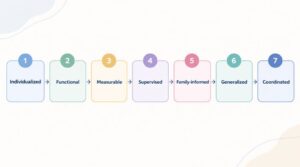
When comparing providers, ask:
- What is my child learning?
- Why does this skill matter?
- How will you measure progress?
- Who is supervising treatment?
- How will my child use this skill in real life?
Those answers can tell you much more than the number of weekly therapy hours.
Explore ABA Therapy at Success On The Spectrum
If you are comparing ABA providers, explore how Success On The Spectrum approaches individualized care, parent involvement, clinical supervision, and real-world skill development.
Explore ABA Therapy at SOS at your Nearest Location
FAQs
Every child is different. Progress varies based on the child, their goals, strengths and needs, consistency of support, and more. An effective program should measure results rather than guarantee a timeline.
Yes. Goals should be reviewed as children learn and how this will affect their requirements. If so, the team should recalculate and adjust depending on whether it is moving forward or not.
Talk with the clinical team. It is important your child feels comfortable and responds to treatment. There are changes to the environment, teaching, support, or relationship between child and therapist the team can look into.
Yes. Even if a child does well in one setting, ABA may encompass goals related to communication, independence, social participation, routine establishment, safety, and other areas.
Think about where your child needs encouragement, and where they need to practice introducing the skills they are acquiring. An effective program should also prepare to assist with transferring skills across settings.

Nichole Daher is an American entrepreneur, book author, autism advocate, and founder of Success On The Spectrum (SOS)-the first autism treatment franchise in the United States-known for its parent viewing rooms and quality-driven ABA services.