
Summary
Babies develop at different rates, and one behavior does not diagnose autism. Parents should watch for persistent patterns in social communication, gestures, shared attention, repetitive behaviors, or developmental regression. If concerns continue, speak with a pediatrician for developmental screening or evaluation. Early support can address a child’s individual needs.
Babies develop at different rates. So when you encounter something that appears to be a little different, it’s understandable to question if that’s just how your baby’s individual development is going or whether you ought to bring it up with a pediatric professional.
There are early developmental differences that are related to autism, including in social communication and interactions. Additionally, children may also demonstrate repeated actions or may find changes and adaptability more difficult. No one behavior alone will diagnose signs of autism in babies.
If a baby does not respond to his name every time, makes less eye contact, or has no use of an iconic gesture, this does not mean the baby has an autistic spectrum behavior.
Developmental milestones will often give expectant parents a rough idea of what age range certain children may be reaching by. According to the CDC, milestones are skills that 75 percent or more of children can perform by a specific age. These milestones are helpful for development monitoring, but they are not a diagnostic tool for autism.
If concerns continue, talking with your child’s doctor about whether there is a need to monitor development over time, monitoring can reveal whether more serious testing (screening) or referral is needed, is the next step.
First: Are These Really “Signs of Autism in Babies”?
Some early characteristics associated with autism can involve:
- Social communication
- Shared attention
- Gestures
- Social engagement
- Response to people
- Repetitive behaviors
- Flexibility and responses to change
But these characteristics can also occur in children who are developing typically or who have other developmental differences.
A developmental sign is an observation, not a diagnosis.
Instead of thinking, “My baby does this, so they have autism,” consider whether you are noticing a consistent pattern of differences and whether other developmental concerns are present.
For example, if a baby consistently has difficulty engaging socially, communicating, or sharing attention, it may be worth discussing those observations with their pediatrician.
Autism is diagnosed through developmental history and behavior. There is no blood test or single medical test that can diagnose it.
Signs to Watch by Age: A Parent-Friendly Observation Guide
The following table is a developmental observation guide, not an autism checklist or scoring system. Babies develop at different rates, and individual observations need to be considered in context.
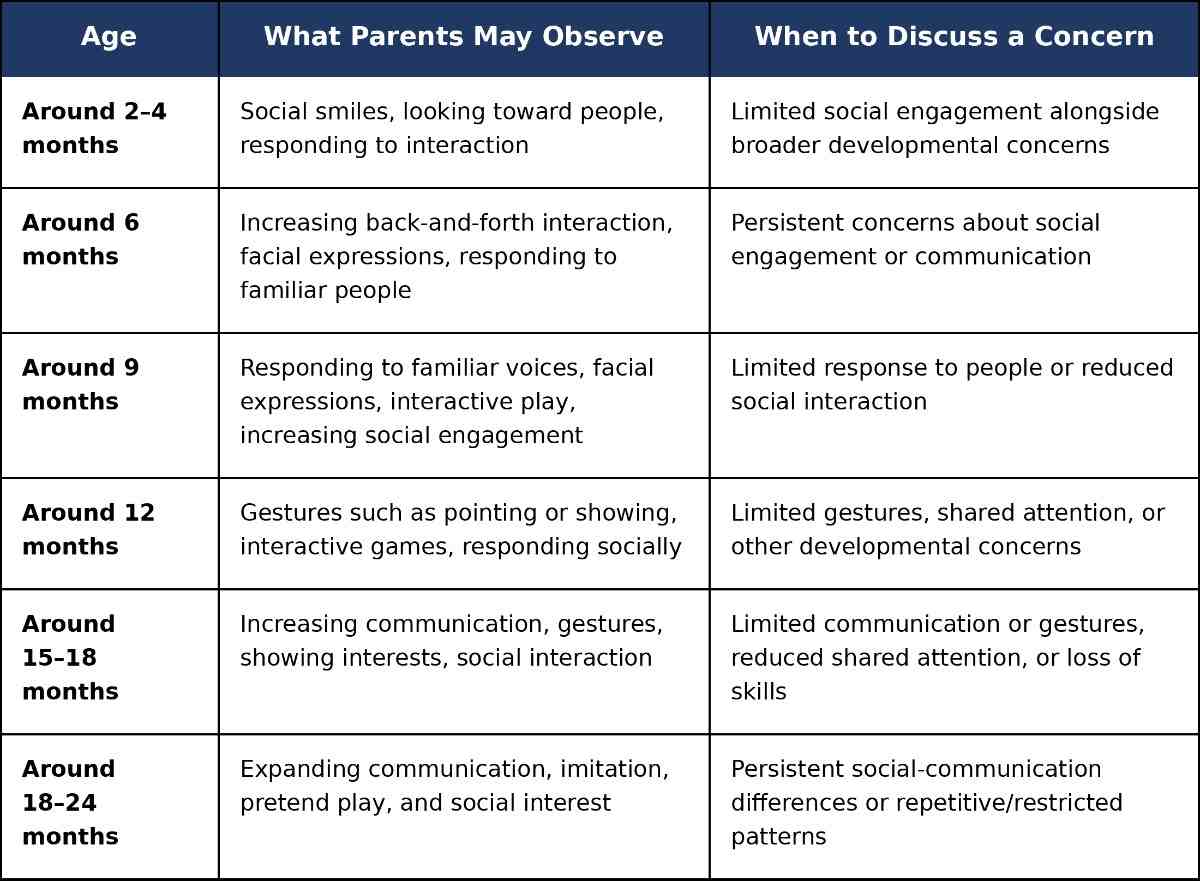
These observations should be used to start a conversation, not to determine whether a child has autism. The CDC and AAP recommend ongoing developmental surveillance, with developmental screening at 9, 18, and 30 months and autism-specific screening at 18 and 24 months. Screening can also be appropriate at other ages when concerns arise.
Early Social Communication Differences Parents May Notice
Rather than looking for one “red flag,” it can be more useful to observe how your baby engages with people over time.
Social Engagement
Parents may notice:
- How often their baby seeks interaction
- How they respond to familiar people
- Whether they participate in back-and-forth social routines
- Whether they share enjoyment during familiar games
Communication
Communication can include much more than spoken words. Watch how your baby uses:
- Gestures
- Sounds
- Facial expressions
- Early words
- Reaching
- Other attempts to communicate wants or interests
Shared Attention
Shared attention, sometimes called joint attention, happens when a child and another person are focused on the same thing and share that experience.
For example, a baby may look at a toy, look toward a parent, and then return their attention to the toy. They are not simply interested in the object. They are involving another person in the experience.
Parents may notice whether their child:
- Looks toward something a parent points out
- Shows a toy or object
- Looks between a person and an object
- Shares enjoyment during an activity
The key is to look at patterns of interaction, rather than treating one missing behavior as proof of autism.
Response to Name: What Does It Really Tell You?
“Why doesn’t my baby respond to their name?” is a common concern.
An inconsistent response to a name can have many explanations. Before assuming it is related to autism, consider the situation.
Ask:
- Is your baby tired?
- Are they deeply focused on something?
- Is there background noise?
- Do they respond in quieter settings?
- Do they respond to familiar voices?
- Could there be a hearing concern?
A baby may not respond every time and still be developing typically.
However, persistent concerns about responding to sounds or a name are worth discussing with a pediatrician, especially when they occur alongside other communication or developmental differences.
Gestures, Pointing and Shared Attention
Gestures provide another useful window into early communication.
Parents can watch for:
- Pointing
- Showing objects
- Reaching to communicate
- Waving
- Imitating gestures
- Looking toward something another person indicates
- Sharing enjoyment
Imagine a baby notices a dog:
Look at dog → looks toward parent → gestures or vocalizes → parent responds.
That sequence shows a shared social experience.
But again, not using a particular gesture at a particular age does not, by itself, mean a child has autism. What matters is the broader developmental picture.
Repetitive Behaviors and Strong Preferences
Another area associated with autism involves restricted or repetitive patterns of behavior and interests.
Parents may notice:
- Repetitive movements
- Repeated sounds or actions
- Repetitive ways of playing
- Strong preferences for particular routines
- Fascination with certain objects or movements
- Distress with some changes
But repetition is also a normal part of early learning. Babies and toddlers naturally repeat actions because repetition helps them explore how things work.
So repetition alone is not evidence of autism.
A professional evaluation considers the pattern, persistence, developmental context, and how behaviors affect everyday functioning.
What Is NOT Specific to Autism?
Many behaviors parents search for online can have several possible explanations.
For example:
- Not making eye contact every time
- Being shy around unfamiliar people
- Preferring certain toys
- Repeating a sound
- Becoming upset when tired
- Having strong food preferences
- Being slow to warm up
- Not responding immediately when deeply focused
- Having a speech delay by itself
These observations deserve context.
One behavior rarely tells the whole developmental story.
Parents do not need to compare their baby with an online symptom list and decide whether they “fit” autism. Instead, track patterns and discuss persistent concerns with a healthcare professional.
What About Developmental Regression?
Parents should also pay attention to loss of previously acquired developmental skills.
Tell your pediatrician if your child loses skills they previously used consistently, particularly skills related to communication or social interaction.
Examples may include losing:
- Previously used words
- Gestures
- Social interaction skills
- Other established abilities
Regression does not automatically mean autism. But a loss of developmental skills deserves prompt discussion with a healthcare professional.
The CDC notes that some children who later receive an autism diagnosis develop skills and meet milestones until around 18 to 24 months and then stop gaining new skills or lose skills they had previously acquired.
What Happens If Your Pediatrician Recommends Further Evaluation?
If concerns continue, the next steps may look something like this:
Concern noticed
↓
Talk with pediatrician
↓
Developmental screening or review
↓
Referral if indicated
↓
Comprehensive evaluation
↓
Understand strengths and needs
↓
Discuss appropriate support
An evaluation may consider:
- Developmental history
- Communication
- Social interaction
- Behavior
- Play
- Repetitive patterns
- Adaptive functioning
- Other developmental factors
The exact process varies by child and provider.
A screening result is not the same as a diagnosis. When developmental concerns are identified, healthcare professionals can determine whether additional assessment or services are appropriate.
What Should Parents Track Before an Evaluation?
Specific observations can be much more useful than broad labels.
Before an appointment, consider writing down:
- What your child communicates
- How they respond to people
- Gestures they use
- Social games they enjoy
- How they respond to their name
- How they interact with objects
- Repetitive behaviors
- Reactions to changes
- Sensory responses
- Skills that appear to have changed
- Differences between home and childcare
- Questions you want to ask the pediatrician
Try to record specific examples.
Instead of:
“My baby doesn’t socialize.”
Write:
“During familiar play, my baby rarely looks toward us or attempts to share attention, even when we initiate the game.”
You can also keep short videos of behaviors that are difficult to describe during an appointment, if appropriate and comfortable for your family.
When Should Parents Ask for Help?
Consider discussing your concerns with a pediatrician when:
- Multiple developmental concerns persist
- Communication seems significantly different from expected development
- Social engagement concerns continue
- You are concerned about gestures or shared attention
- Repetitive behaviors are persistent and concerning
- Your child loses previously acquired skills
- Developmental differences affect everyday participation
- You simply have an ongoing concern about your child’s development
You do not need to prove that your child has autism before asking for help.
The AAP recommends developmental surveillance at every health supervision visit and encourages providers to respond when parents raise developmental concerns.
A conversation with your pediatrician may lead to reassurance, continued monitoring, developmental screening, or referral for further evaluation.
Any of these can be an appropriate next step.
What Early Support Can Look Like
Parents do not always have to wait for an autism diagnosis to meet a developmental need.
Support may incorporate the following depending on a child’s requirements:
- Speech therapy
- Occupational therapy
- Developmental support
- Parent coaching
- Early-intervention services
- Behavioral support when clinically appropriate
Your support should be determined by your child’s individual developmental needs, not based on an assumed diagnosis.
This is also where a coordinated response can be advantageous. Success On The Spectrum includes ABA therapy, speech therapy, occupational therapy, and social skills training as part of autism services that are customized to the individual child’s needs and goals.
Work organized by SOS focuses on parent participation and practical skills. When support is suggested, families can collaborate with providers to understand what their child is working on, why a goal is meaningful, and how skills transfer into daily life routines.
This is about not putting a label on a baby. It is to recognize the patterns of development and how we can lend a supportive hand during times when support is required.
The Bottom Line: Watch Patterns, Not Checkboxes
There is no single “sign of autism in babies” that can tell you whether a baby is autistic.
Instead, parents can:
Observe → Track patterns → Discuss concerns → Screen when appropriate → Seek professional evaluation
Developmental differences can have many explanations. A concern may eventually lead to an autism diagnosis, another developmental diagnosis, a recommendation for additional support, or simply continued monitoring.
What matters is that parents do not have to figure it out alone.
The earlier a concern is discussed, the sooner families can understand what their child may need, whether or not the eventual evaluation results in an autism diagnosis.
Talk With a Professional About Your Child’s Development
If you’re noticing differences in your child’s communication, social interaction, development, or behavior, you do not have to determine what they mean by yourself.
A pediatrician can help you decide whether your child would benefit from developmental screening, further evaluation, or another type of support.
Learn About Autism Evaluation at Success On The Spectrum
FAQs
Yes. Early differences do not always mean autism. Development varies, so ongoing patterns and professional evaluation matter.
Yes. Tiredness, illness, discomfort, or overstimulation can temporarily affect behavior.
Yes. Hearing difficulties can affect responses to voices, sounds, or their name. A hearing check may be helpful.
No. Some autistic children make eye contact. Eye contact alone cannot determine autism.
Not necessarily. Repetitive behaviors can be typical in babies. Persistent or unusual behaviors should be discussed with a pediatrician.

The Success On The Spectrum Editorial Team shares guidance and resources for families on autism, ABA therapy, speech therapy, and occupational therapy from Success On The Spectrum.