
Summary
Online autism screeners can help identify whether a child may need further evaluation, but they cannot diagnose autism. Screening results may be positive or negative without confirming or ruling out autism. Parents should discuss concerns with a qualified professional, who can assess developmental history, communication, behavior, social interaction, and everyday functioning to determine appropriate next steps.
If you searched online for an “autism test for kids,” the search results might have pointed to well-known questionnaires across a range of domains, from communication, social interactions, and play to behavior and looking for repetitive movements.
A questionnaire typically completed online will help you gain an impression of whether there is a problem with your child’s growth, but not diagnose autism.
Screening tools tell you if the child might need more tests. When used, a professional will review the child’s background history of behaviors and social interactions, communication abilities, and all other factors to develop this diagnosis.
Is There an Autism Test You Can Take Online?
Yes, online autism screening questionnaires are available. They can help answer:
“Could these signs suggest a need for further evaluation?”
They cannot answer:
“Does my child have autism?”
An online screener cannot:
- Confirm or rule out autism
- Replace a professional evaluation
- Provide a complete developmental profile
- Identify every developmental or behavioral concern
- Recommend specific treatment
Important: An online autism screener can suggest that a closer look may be helpful, but it cannot confirm or rule out autism.
SCHEDULE A VIRTUAL DIAGNOSTIC EVALUATION
Autism Screening vs. Autism Diagnosis: What’s the Difference?
Screening and diagnosis are connected, but they serve different purposes.
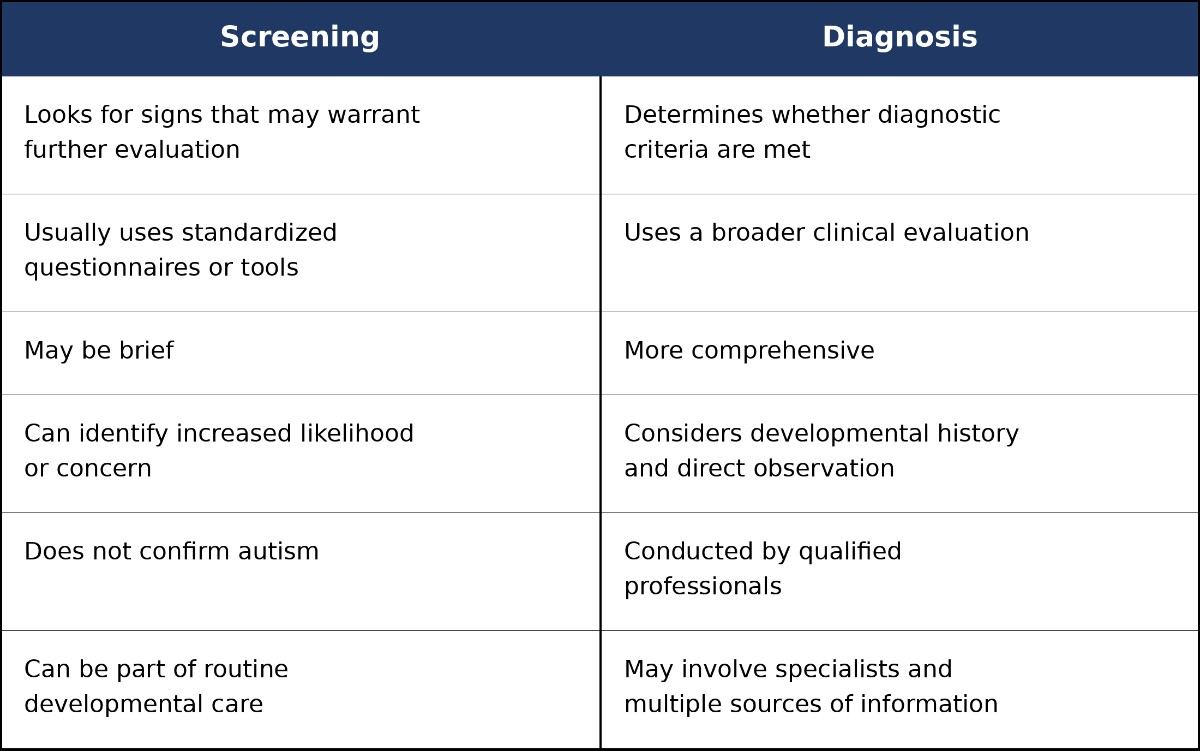
The American Academy of Pediatrics recommends autism-specific screening at 18 and 24 months, along with ongoing developmental surveillance. Screening helps identify children who may need additional evaluation. A diagnostic evaluation goes further by considering developmental history, behavior, observation, and other relevant information.
Key Takeaway
A screening result tells you what to do next, not what diagnosis your child has.
A positive screen does not automatically mean your child is autistic. A negative screen also should not automatically end the conversation if developmental concerns continue.
What Does an Autism Screening Tool Look At?
Screening questionnaires may ask about several areas of development.
Communication
Questions may consider:
- Responding to others
- Use of gestures
- Language use
- Understanding communication
- Back-and-forth interaction
Social Interaction
A screener may ask about:
- Interest in people
- Sharing attention or enjoyment
- Social responses
- Interaction with peers
- Responding to social approaches
Behavior and Play
Questions may also address:
- Repetitive behaviors
- Repetitive play
- Strong interests
- Reactions to changes
- Preferences for routines
Development
Some tools consider:
- Developmental milestones
- Changes in development
- Loss of previously acquired skills
- Everyday functioning
They help identify patterns that might be worth investigating further. They do not mean that any one behavior is diagnostic.
To illustrate, a child who loves the same repetitive play may do far more than we can theorize. A clinician puts that behavior in context with the rest of a child’s developmental history and presentation at this time.
As the CDC notes, screening and diagnosis are not the same processes: The CDC offers several developmental and autism screening tools such as the Modified Checklist for Autism in Toddlers (M-CHAT).
Why Can Autism Screeners Have False Positives or False Negatives?
No screening tool provides a perfect answer.
False Positive
A positive screening indicates more concern than for other children without an Autism Spectrum Disorder, but this may not lead to a diagnosis of autism later when the child is better examined.
This may occur because some traits linked to autism can also be seen with other developmental, behavioral, communication, or learning problems.
A child has something called a language delay or another developmental issue that makes it difficult for them to speak or interact socially, etc.
False Negative
A false negative results when the screening is not alarming enough, yet an evaluation by a healthcare expert reveals autism later.
This is just one more reason for parents not to equate a screening score with the whole answer.
Estimates of general performance in selecting children referred for further evaluation by age group, population, or setting can be obtained from individual screening tool research.
A 2024 systematic review and meta-analysis reported that the M-CHAT-R/F, a commonly used autism screening tool for young children, had an estimated 78% sensitivity and 98% specificity across the studies included.
Does Age Matter When Screening for Autism?
Different tools are for different age groups, so we should use tools appropriately.
Developmental screening at 9, 18, and 30 months (autism-specific screening beginning at 18 months) has also been endorsed by the American Academy of Pediatrics. Developmental monitoring continues as children grow.
Older children may also be recognised as having autism when they are expected to cope with more socialisation and academic pressures. Parents or teachers may notice:
- Difficulty with peer relationships
- Communication differences
- Repetitive behaviors or focused interests
- Difficulty adapting to change
- Challenges in the classroom
- How these differences become more pronounced over the years
The American Academy of Pediatrics recommends autism-specific screening at the 18- and 24-month visits, while developmental surveillance continues throughout childhood. Concerns that arise at other ages can also warrant additional screening or evaluation.
Parent Takeaway
If concerns appear after the typical toddler screening period, it is not “too late” to seek an evaluation.
The CDC notes that some people are not diagnosed until adolescence or adulthood. Parents can discuss developmental concerns with a healthcare professional at any age.
What Happens After a Positive Autism Screen?
A positive screening result should lead to a conversation, not a conclusion.
Step 1: Discuss the Result
Talk with your child’s pediatrician or another qualified professional.
Bring the screening result and explain what prompted you to complete it.
Step 2: Review Developmental Concerns
Share specific examples from:
- Home
- School
- Childcare
- Community settings
Your observations help provide a broader picture of how your child functions across environments.
Step 3: Arrange a Comprehensive Evaluation
Depending on the child’s needs and available resources, evaluation may involve a developmental pediatrician, psychologist, psychiatrist, neurologist, or another appropriately trained professional.
The AAP notes that diagnostic evaluations may involve different professionals and should consider developmental history and direct observation.
Step 4: Consider Other Developmental Assessments or Services
Depending on what the evaluation identifies, additional assessment may look at:
- Language
- Cognitive or developmental skills
- Adaptive functioning
- Motor skills
- Hearing
- Behavioral concerns
- Other developmental needs
Step 5: Plan Next Steps
Support should be based on the child’s identified needs, not simply on whether a screening score was positive.
What Should Parents Bring to an Autism Evaluation?
You do not need to create a perfect medical file before an evaluation.
However, preparing useful information can make it easier to explain your concerns.
Consider bringing:
- Developmental history
- Previous evaluation reports
- Pediatric records
- School or teacher observations
- Examples of communication
- Examples of social interaction
- Repetitive behavior observations
- Sensory observations
- Information about daily routines
- Relevant videos showing natural behavior, when appropriate
Specific examples are especially helpful.
Instead of:
“My child doesn’t socialize.”
Try:
“At school, my child rarely initiates interaction with peers and usually needs an adult to enter a group activity.”
The second description gives the evaluator more context about what happens, where it happens, and what level of support may be needed.
The AAP emphasizes the importance of developmental history that reflects the child’s functioning across family, peer, and school environments.
What Does a Professional Autism Evaluation Look At?
A professional autism assessment is not just another online “test”.
This takes a general view of development.
Developmental History
They might want to know what development looked like over time – how has your child communicated? How have they developed socially? What is their play like, and what are their learning and behavior patterns?
Communication
That includes how your child understands and also relates to other people. This includes spoken language, gestures, signs, AAC, or other modes of communication.
Social Interaction
The professional might observe your child’s interactions with adults and other children, responses to others, or how they initiate an interaction or participate in an exchange.
Restricted or Repetitive Patterns
The assessment can include various levels of constant repetitive behaviors, as well as narrow interests, habits, or resistance to change.
Observation
The professional may observe your child in person and use standardized or semi-structured assessments depending on the evaluation.
Functional Impact
Next, the evaluator considers how these characteristics affect day-to-day life for school, family activities, communication, learning, self-care, and social participation.
Diagnosis would ordinarily be based on two cornerstones: accounts of development by the people raising children and behavioral evaluations by trained professionals, according to the CDC. Diagnosis should not be based on one single diagnostic tool.
Key Message
Diagnosis looks at the whole child, not one questionnaire score.
When Should Parents Seek Professional Guidance?
Parents do not need to wait for an online screening result if they already have concerns.
Consider talking with your child’s pediatrician or a qualified professional when you notice persistent concerns involving:
- Communication
- Social interaction
- Play
- Repetitive behaviors
- Strong preference for routines
- Sensory responses
- Developmental regression
- School participation
- Everyday functioning
You do not need to diagnose your child before asking for an evaluation.
Your concern is enough reason to start a conversation.
The CDC recommends discussing developmental concerns with a child’s healthcare provider and notes that screening can also be appropriate outside routine screening ages when concerns arise.
Autism Test for Kids: What Parents Can Do Next
If you are unsure what to do, think of the process as a pathway rather than a single test.
If You’re Just Noticing Concerns:
Observe → Document → Talk with your pediatrician
If a Screening Tool Suggests Increased Concern:
Review results → Discuss with a professional → Arrange evaluation
If Screening Is Negative but Concerns Continue:
Don’t dismiss concerns → Discuss them → Consider further developmental evaluation
A negative screen does not mean you have to ignore persistent developmental concerns.
If Autism Is Diagnosed:
Understand strengths and needs → Discuss supports → Build an individualized plan
If Autism Is Not Diagnosed:
Continue addressing any developmental concerns identified during the evaluation.
Your child may still benefit from support for communication, learning, behavior, social participation, daily living, or other identified needs.
The goal isn’t simply:
“Get an autism diagnosis.”
The goal is:
“Understand what support this child needs.”
The American Academy of Pediatrics recommends connecting children with developmental concerns to appropriate evaluation and services rather than allowing the diagnostic process to become the only focus.
The Bottom Line: Don’t Use a Test to Diagnose. Use It to Know What to Do Next.
Searching for an “autism test for kids” is often really a search for an answer to a much bigger question:
“Should I be concerned, and what should I do next?”
Having a tool to screen whether more investigation is warranted. However, it cannot diagnose autism or offer a comprehensive overview of the growth process in children.
Diagnosis by a professional is necessary to assess the wider developmental picture, including history, behavior patterns in communication and social interactions, along with restricted or repetitive behaviors on a day-to-day functional level.
Remember the pathway:
Concern → Screening → Professional follow-up → Comprehensive evaluation → Individualized next steps
You do not have to figure everything out on your own.
Take the Next Step With a Professional Evaluation
If you’re concerned about your child’s development, communication, social interaction, or behavior, you don’t need to determine the diagnosis yourself.
A professional evaluation can help clarify your child’s strengths, needs, and appropriate next steps.
Find Our Location for Autism Test
FAQs
Free online autism screening questionnaires are available, but they cannot diagnose autism disorder. Important information: A screening tool may point toward the usefulness of additional evaluation. Discuss any concerns about your child's development with a qualified health professional.
No. Although an online questionnaire may help with screening, it cannot offer an official diagnosis of autism. Diagnosis takes the form of a qualified professional reviewing developmental history, current behavior, and other relevant information.
If the screening result is high or positive, it means your child may need more extensive testing. The way you teach your child will not change what it does for that. Discuss the result with your child's pediatrician or another mental health professional to see if a full evaluation is warranted.
Talk to your child's doctor from time to time. Screening tools, however, are fallible, and negative outcomes do not necessarily account for chronic developmental issues. You should consider your child's developmental history and functioning.
Autism can present itself in early childhood, and autism-specific screening is recommended at 18 and 24 months (American Academy of Pediatrics). None of which stops the child from being assessed when concerns are raised later on. Developmental surveillance should be an ongoing process throughout childhood.

The Success On The Spectrum Editorial Team shares guidance and resources for families on autism, ABA therapy, speech therapy, and occupational therapy from Success On The Spectrum.