
Summary
An autism diagnosis checklist helps parents organize observations before a professional evaluation. Track developmental history, communication, social interaction, repetitive behaviors, sensory differences, and daily-life impact. Include specific examples from home, school, and community settings, along with relevant records and questions. The checklist supports preparation but cannot diagnose autism; professional evaluation is essential.
You may have seen changes in your child’s communication, socialization, play, or behavior, or a difference in their motor skills. Whether your child is developing at a pace different from his or her peers, or you have observed changes that you cannot fully explain.
If you are wondering if an autism evaluation is right, it can be useful to organize what you have noticed before your appointment.
Having a checklist can give you at least something to start with.
But there is one important distinction to make from the beginning:
This is an observation-preparation autism diagnosis checklist, not a medical diagnosis.
Online lists of behaviors do not diagnose autism. There is no single blood test or screening tool to confirm autism. An assessment by a professional includes the child’s development history and current display of skills, as well as communication patterns, social interaction, and other related factors.
Before the Checklist: This Is Not a Diagnostic Tool
Checking several items does not mean your child is autistic.
Not checking an item does not rule autism out.
Different children develop differently, and similar behaviors may have different reasons. For example, some children may have developmental delays, language differences, sensory differences, anxiety (neuroticism), attention difficulties (ADHD), and possibly other things that can affect communication or behavior.
Formal assessments examine the general progression of a child’s development, not just one behavior alone. The CDC further adds that no individual diagnostic test should be the sole basis for an autism diagnosis.
For more on autism screening and assessment, parents can also see resources from the Autism Research Institute.
| IMPORTANT: This checklist cannot diagnose autism.
Use it to organize observations and questions you may want to discuss with a qualified professional. |
What Should Parents Track Before an Autism Evaluation?
Before your appointment, focus on six areas:
- Developmental history
- Communication
- Social interaction
- Repetitive behaviors and interests
- Sensory differences
- Function across environments
Try to record specific examples rather than labels.
For example:
Less useful:
“My child has poor social skills.”
More useful:
“At preschool, my child rarely approaches other children to start play and usually plays alone unless an adult joins.”
The second example gives an evaluator much more information.
Think about:
- What happens?
- When does it happen?
- Where does it happen?
- How often does it happen?
- What happens before or after it?
- How does it affect everyday life?
These details can help a professional better understand your child’s development.
Autism Observation Checklist for Parents
1. Developmental History
Start by looking at your child’s development over time.
Track:
- When communication milestones emerged
- Early social behaviors
- Development of play skills
- Major developmental concerns
- Any loss of previously acquired skills, if applicable
- Previous developmental evaluations
- Relevant medical or developmental history
- Concerns that have remained consistent over time
You do not need to remember every detail perfectly. Old videos, photographs, school records, pediatric records, and previous reports may help you reconstruct your child’s developmental history.
Parent Prompt
“What did my child do before, and what do they do now?”
A change in development can be especially important to mention to the professional. The CDC notes that some children may develop skills and meet milestones before later showing developmental changes or losing previously acquired skills.
2. Communication
Communication involves more than spoken words.
Observe how your child communicates wants, needs, interests, feelings, and ideas.
Consider:
- How your child asks for something
- Use of words or phrases
- Use of gestures, signs, or AAC
- Understanding spoken language
- Responding when spoken to
- Back-and-forth communication
- Repetition of words or phrases
- Ability to communicate in different situations
- Whether communication changes with familiar and unfamiliar people
Avoid treating speech delay as synonymous with autism.
Some autistic children speak fluently, while others communicate primarily through non-speaking methods or use AAC. Communication abilities can also change depending on the setting, person, activity, or level of support.
3. Social Interaction
You can train kids in how social interaction looks, but what they do well is documented by observation- whatever you get to see.
You might track:
- Responding to their name
- Sharing interests or pleasure with others
- Initiating interaction
- Responding when someone approaches them
- Participating in back-and-forth interaction
- Playing alongside or with peers
- Joining group activities
- Social attention
- Recognizing or replying to social cues
- Showing interest in other children
Instead of section writing “does not interact with peers,” write what occurs:
‘My child watches other kids playing instead of playing with them unless an adult guides him.
The point aims not to transform single observations into diagnostic deductions. An expert thinks of the way many traits interact throughout the developmental lifespan for a child.
4. Repetitive Behaviors, Interests and Routines
Some children show repetitive movements, repeated speech, strong interests, or a strong preference for predictable routines.
Parents can document:
- Repetitive movements
- Repetitive play
- Repeated words or phrases
- Strong or highly focused interests
- Preference for familiar routines
- Distress around changes
- Repeated ways of interacting with objects
- Difficulty with transitions
Be specific.
Instead of:
“Obsessed with cars.”
Try:
“For the past six months, my child has spent much of their free time arranging toy cars in precise rows and becoming upset when someone moves them.”
This gives the evaluator information about the behavior, its duration, and its effect.
The CDC identifies restricted or repetitive behaviors, interests, and patterns of sameness as important parts of autism assessment.
5. Sensory Differences
You may also want to document how your child responds to sensory experiences.
Pay attention to reactions to:
- Sounds
- Touch
- Clothing
- Food textures
- Smells
- Lights
- Movement
- Crowded environments
Record whether your child:
- Avoids certain sensations
- Seeks particular sensory experiences
- Becomes overwhelmed
- Has unusually strong reactions
- Appears less responsive than expected to certain sensations
For example:
“My child covers their ears and becomes distressed when the vacuum cleaner is turned on.”
This is more useful than simply writing “has sensory issues.”
Sensory differences can occur for many reasons and do not independently diagnose autism. They are one part of a much broader developmental picture.
6. Daily-Life Impact
One of the most useful questions to ask is:
“How are these differences affecting everyday participation?”
Document concerns involving:
- Dressing
- Feeding
- Sleep routines
- School
- Play
- Family routines
- Community activities
- Transitions
- Independence
- Following everyday routines
This moves the conversation beyond simply listing behaviors.
For example:
“My child becomes very upset when we leave the house unexpectedly and needs an adult to help them transition.”
The goal is to help the evaluator understand how your child’s characteristics affect participation in daily life.
Ask for Feedback From School or Childcare
Parents see an important part of a child’s development, but they may not see everything.
Ask teachers, daycare providers, or other caregivers what they notice about:
- Peer interaction
- Communication
- Classroom participation
- Transitions
- Play
- Repetitive behaviors
- Sensory responses
- Following routines
- Independence
Ask for specific examples rather than simply asking, “Do you think my child has autism?”
For example:
- “Does my child join other children during free play?”
- “What happens when the classroom routine changes?”
- “How does my child communicate when they need help?”
School and childcare observations can help an evaluator understand whether a behavior appears in more than one environment.
Bring Examples, Videos, and Existing Records
You do not need to walk into an evaluation with a perfect file.
However, useful information may include:
- Developmental records
- Previous assessment reports
- School reports
- Teacher observations
- Speech or OT reports, if applicable
- Developmental screening results
- Relevant medical records
- Short videos showing everyday behaviors, when appropriate and when privacy can be maintained
Videos can be particularly useful when a behavior does not happen during an appointment.
However, do not stage behaviors for an evaluation.
Natural examples from everyday life can provide context. Your goal is to show the evaluator what your child’s typical experiences look like, not to create a specific response.
Watch: The Importance of Early Diagnosis
Parents who are beginning to have developmental concerns often have questions about why evaluation matters and what early identification can mean.
The video below provides additional context about the importance of early diagnosis and seeking appropriate support.
YouTube Video Link: The Importance of Early Diagnosis
An evaluation is not about rushing to place a label on a child. It is about understanding development and determining whether further assessment or support may be appropriate.
Screening vs. Diagnosis: What’s the Difference?
Screening and diagnosis are not the same; they relate to each other.
Screening
Screening tools help to quickly identify children who should be evaluated more thoroughly.
It can help answer:
“Should we look more closely?”
Screening can consist of questionnaires or structured instruments that assess areas such as communication, development, behavior, or social interaction. A positive screen is not diagnostic of autism.
Diagnosis
A diagnostic evaluation poses a much wider question:
“Does the child’s developmental pattern meet the criteria for autism?”
In evaluating, a professional takes into consideration developmental history, current presentation, behavior, communication and social interaction, as well as restricted or repetitive behaviors and other relevant factors.
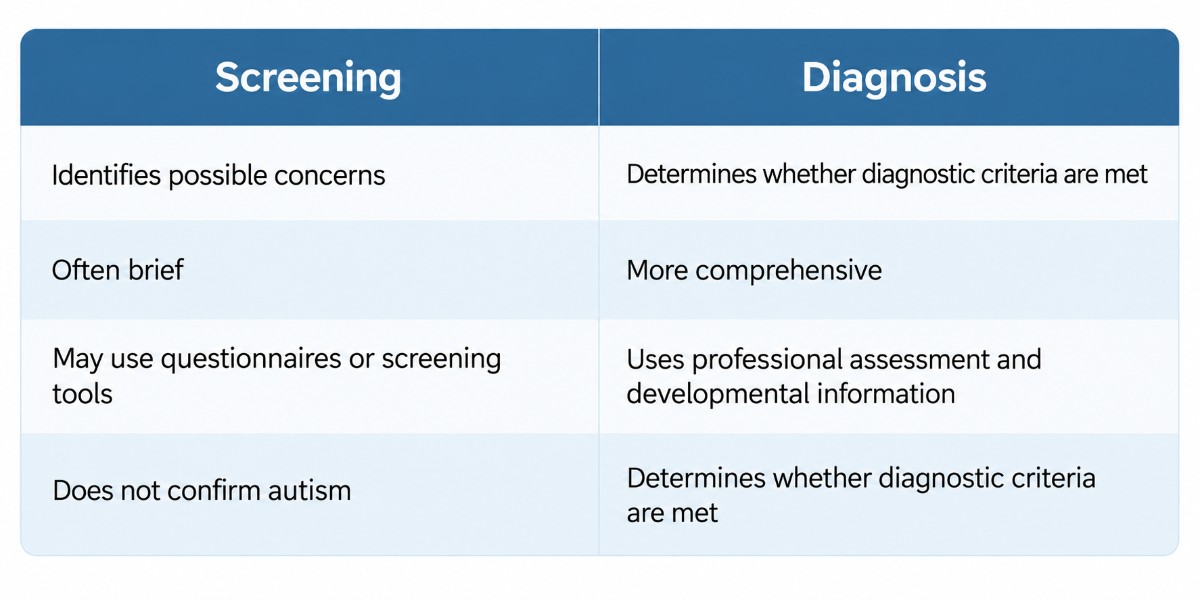
The CDC states that there is no single medical test for autism and that diagnosis relies on developmental history and professional observation and assessment.
What Happens During an Autism Evaluation?
Every evaluation is not the same. The process can vary based on the child’s age, concerns, provider, and setting.
A general evaluation may include:
Step 1: Developmental History
The professional asks about:
- Early development
- Communication
- Social development
- Behavior
- Learning
- Daily functioning
Step 2: Parent Interview
Parents illustrate their worries with examples from home, school, and community.
What you see is important because only a parent can observe their child in this context and during the course of their life.
Step 3: Direct Observation or Assessment
Depending on the provider and child, evaluation may involve more structured or standard activities led by a person who is clinically relevant.
They will assess areas such as communication, social skills, play, behavior, and other milestones.
Step 4: Review of Information
The clinician considers the available information together, including:
- Developmental history
- Current presentation
- Communication
- Social interaction
- Restricted or repetitive behaviors
- Functional impact
- Other relevant developmental factors
No single behavior or questionnaire score determines the outcome.
Step 5: Feedback and Recommendations
The evaluation findings, along with recommendations for next steps and services when applicable, are relayed to the family.
The above recommendations can be different for each child based on his or her strengths and weaknesses.
Questions to Bring to the Autism Evaluation
Writing down your questions before the appointment can help you make the most of your time.
About the Evaluation
- What will the evaluation involve?
- Who will conduct it?
- What information should I bring?
- How long should we expect the process to take?
About the Findings
- What observations contributed to your conclusion?
- What strengths did you identify?
- Are there other developmental concerns we should evaluate?
About Next Steps
- What support does my child need?
- Should we consider speech therapy?
- Would occupational therapy be appropriate?
- Would behavioral support be appropriate?
- What should we prioritize first?
- Who should we follow up with?
You do not have to know which services your child needs before the evaluation. That is part of what the assessment can help clarify.
What If Your Child Doesn’t Receive an Autism Diagnosis?
Even when the result is not that of autism, conducting an evaluation still proves useful.
Still, developmental concerns are considerable.
A child may be supported for:
- Speech and language
- Occupational skills
- Learning
- Behavior
- Social participation
- Developmental delays
- Other identified needs
Getting a label is not the point of an evaluation. It is to understand what a child may need to receive support.
Depending on the concerns identified, a professional may also suggest further evaluation or other services. By detecting potential developmental problems early, families can get the referrals they need.
Autism Diagnosis Checklist: One-Page Parent Prep
Before the appointment, have I documented:
- Developmental history
- Communication examples
- Social interaction examples
- Repetitive behaviors or interests
- Sensory observations
- Daily-life impact
- School or childcare feedback
- Previous evaluations or reports
- Relevant videos or everyday examples
- Questions for the evaluator
This autism diagnosis checklist helps you prepare for an evaluation. It does not diagnose autism.
You can save this list on your phone or print it before your child’s appointment.
The Bottom Line: Document, Don’t Diagnose
Parents do not need to determine whether their child is autistic before seeking professional guidance.
Your job is to observe, document, and share.
A useful record can help a professional understand:
what the child does → when it happens → where it happens → how consistently it occurs → how it affects everyday life.
A qualified professional then uses that information alongside clinical assessment to determine the appropriate next steps.
If something about your child’s development concerns you, you do not have to wait until you have every answer. Bring your observations to your child’s healthcare provider and ask whether further developmental screening or evaluation is appropriate.
Start With a Professional Evaluation
If you’re concerned about your child’s communication, social interaction, development, behavior, or everyday participation, an evaluation can help you better understand their individual strengths and support needs.
Learn About Autism Evaluations at SOS
FAQs
Yes. Autism can present differently from one child to another, and some children may have characteristics that are less obvious in everyday settings. This is one reason an evaluation should consider the child's overall developmental history and current functioning rather than relying on a short checklist.
Yes. Speaking, making eye contact, or performing well academically does not by itself rule out autism. Autism involves a broader pattern of social communication and interaction alongside restricted or repetitive behaviors or interests. Individual abilities can vary significantly among autistic children.
Yes. Autism can be diagnosed beyond early childhood. Some people are not diagnosed until adolescence or adulthood. If concerns remain, parents, caregivers, or older individuals can discuss them with a qualified healthcare professional.
Several developmental or behavioral conditions can involve communication, learning, attention, behavior, or social challenges. Some characteristics can overlap. A professional evaluation helps determine whether the child's overall developmental pattern meets criteria for autism and whether other concerns may also need attention.
If you have ongoing concerns about your child's development, it is better to discuss them with a healthcare provider rather than simply waiting. Developmental monitoring and screening can help identify concerns and determine whether further evaluation is appropriate.

The Success On The Spectrum Editorial Team shares guidance and resources for families on autism, ABA therapy, speech therapy, and occupational therapy from Success On The Spectrum.