


Summary
The best activities for autistic children should be chosen based on individual goals, sensory needs, and social demands. Activities can support communication, motor skills, regulation, social interaction, and independence. Parents should adapt activities to their child’s abilities, interests, and comfort, observe responses, prioritize safety, and involve therapists when individualized support is needed.
Type “activities for kids with autism” in Google, and there are thousands of results: crafts, sensory bins, movement games, puzzles, and outdoor activities.
Just because something is tagged as “autism-friendly” does not mean that it is helpful as a strategy.
A better question is:
What activity can your child engage in at this point, and what skill level do you want to support?
At Success On The Spectrum (SOS), we base our activities and interventions around functional skills that will make a difference: communication, social, independence, learning, and participation. Use that same approach to decide what activities to do at home for parents.
A simple way to think about it is:
Goal × Sensory Load × Social Demand
An activity may be excellent for communication but too socially demanding. A movement activity may support gross motor skills but provide more sensory input than a child can comfortably manage. Another activity may help a child regulate but have little connection to the developmental skill you are currently working on.
The best activities for kids with autism.
What Makes an Activity a Good Fit for an Autistic Child?
There is no universal “autism activity.”
The right activity depends on:
- What your child enjoys
- What they are learning
- How they communicate
- Their sensory preferences
- Their attention and regulation
- Their motor abilities
- How much social interaction they currently tolerate
- How much adult support they need
An activity that works well for one autistic child may be boring, uncomfortable, or too difficult for another.
Match the activity to the child—not the child to the activity.
The SOS Activity Picker: Goal × Sensory Load × Social Demand
Before choosing an activity, consider three questions.
1. What Is the Developmental Goal?
Start with what you want your child to practice.
Communication
- Requesting
- Making choices
- Following directions
- Using AAC
- Turn-taking
Motor
- Fine motor skills
- Gross motor skills
- Bilateral coordination
- Visual-motor skills
Regulation
- Recognizing body states
- Taking movement breaks
- Using preferred coping strategies
- Transitioning between activities
Social
- Joint activities
- Turn-taking
- Conversation
- Cooperative play
Life Skills
- Dressing
- Cleaning up
- Feeding routines
- Simple household tasks
2. What Is the Sensory Load?
Each child processes sensory input differently.
Stop assuming your autistic child has trouble with sensory input and observe them closely. Notice what they are attracted to, what pushes them away, and what is too much for them to handle.
- Low sensory load: Predictable soft, quiet materials
- Moderate sensory stimulation: some movement, some novel textures or sounds or shapes present in the environment.
- More sensory load: Messy textures, loud noise, fast movement or energy, tight spaces, too many people close to each other, or so much happening at the same time.
These differences in sensory needs can have a profound impact on how your child engages with play and learning, transitions, and even everyday tasks. Reference your child orienting to the sensory input and regulation of this use via co-regulation, play therapy, or art therapy.
3. How Much Social Demand Does It Have?
Social participation can also be graded.
- Low: Independent play or an adult nearby.
- Moderate: One-to-one interaction and simple turn-taking.
- Higher: Cooperative play, peer interaction, or group activities.
A child who is not ready for a four-person board game may still be ready for a simple turn-taking game with a parent.
The goal is to build participation gradually.
The Activity Matrix
Use this quick guide to match an activity with a goal.
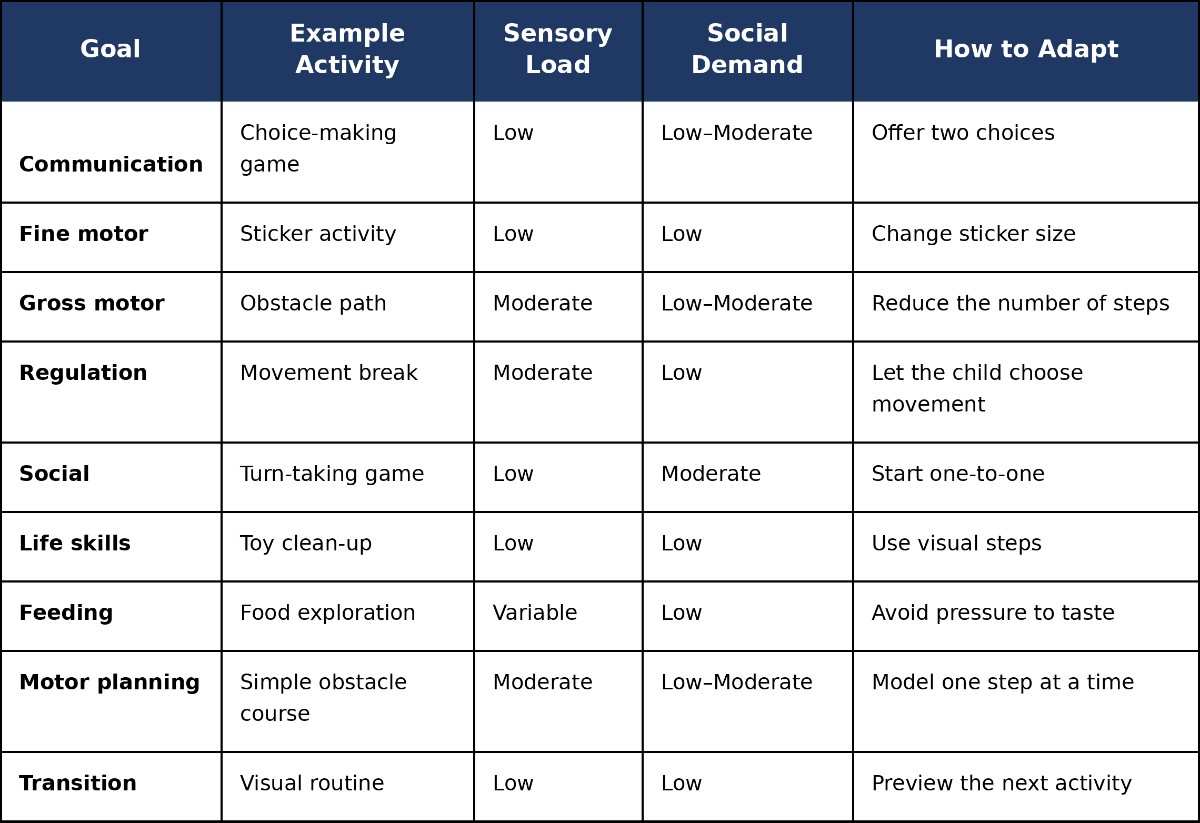
Why it helps: The activity matters less than the functional skill it gives your child an opportunity to practice.
Communication Activities: Build Communication Into Play
Communication practice does not have to look like a speech drill. Everyday play can create natural opportunities to communicate.
Choice-Making
Offer two options:
“Do you want blocks or cars?”
This gives your child an opportunity to make a choice using speech, gestures, pictures, AAC, or another communication method.
Requesting
Place a preferred toy or material where your child can see it but cannot immediately reach it. Allow them to request it rather than automatically handing it over.
Do not turn this into a test. The goal is to create a meaningful communication opportunity.
AAC
If your child uses AAC, model their communication system during play. AAC can supplement spoken communication or provide an alternative when speech does not meet a person’s communication needs.
The goal is communication, not spoken language specifically.
Following Directions
Use familiar activities to practice simple directions:
“Put the block in.”
“Give me the ball.”
“Put the car here.”
Start with directions your child can reasonably understand, then gradually increase the challenge.
Motor Activities: Match the Challenge to the Child
Motor activities can be adjusted to support different skills.
Fine Motor
Try:
- Stickers
- Play dough tools
- Simple puzzles
- Peg activities
- Drawing
Bilateral Coordination
Try:
- Building with blocks
- Opening containers
- Two-handed craft activities
- Pulling apart and connecting toys
Gross Motor
Try:
- Walking paths
- Ball play
- Simple obstacle courses
- Animal walks
- Movement games
Visual-Motor Skills
Try:
- Matching activities
- Simple mazes
- Building from a model
- Shape activities
If an activity is too easy, add another step or increase independence.
If it is too difficult, simplify the task, reduce the number of steps, or demonstrate it first.
The goal is participation and skill development—not perfect performance.
Regulation Activities: Don’t Assume Every Child Needs the Same Sensory Input
“Sensory activity” does not automatically mean “more sensory input.”
Some children may enjoy movement, while others may become overwhelmed by it. Some may seek certain textures, while others avoid them.
Possible regulation activities include:
- Quiet time in a calm space
- Predictable movement
- Slow stretching
- Drawing
- Listening to preferred sounds
- Looking at books
- Short movement breaks
- Familiar repetitive activities
After trying an activity, observe your child.
Ask:
- Do they appear calmer afterward?
- Can they return to the activity?
- Did the activity increase distress?
- Are they asking for it again?
- Does it help in more than one situation?
If an activity consistently increases distress, stop and reassess. You do not need to assume your child simply needs to “get used to it.”
When sensory differences consistently interfere with everyday participation, an occupational therapist can help assess the child’s needs and identify individualized strategies. SOS’s occupational therapy services focus on areas including daily living, coordination, sensory regulation, and independence.
Social Activities: Start With the Right Social Demand
Social participation can be built gradually.
Low Social Demand
- Playing alongside a parent
- Reading a book together
- Parallel play
- Shared drawing
Moderate Social Demand
- Turn-taking games
- Building something together
- Simple cooperative tasks
- Taking turns with a ball
Higher Social Demand
- Small-group games
- Peer projects
- Group activities
- Community activities
For example:
Independent activity → parent turn-taking → sibling → one peer → small group
This gives your child opportunities to practice social skills without immediately placing them in the most demanding situation.
SOS uses purpose-built social rooms, group activities, and community opportunities to help children practice skills such as sharing, turn-taking, teamwork, communication, and social interaction.
Life-Skill Activities: Make Everyday Routines the Activity
Not every developmental activity needs to be a game.
Everyday routines can provide meaningful opportunities to build independence.
Dressing
- Match socks
- Practice fasteners
- Follow a dressing sequence
Feeding
- Help prepare food
- Choose between foods
- Participate in cleanup
Avoid pressuring a child to taste food as part of an activity. Follow appropriate professional guidance when feeding concerns are significant.
Household Tasks
- Sort laundry
- Put toys away
- Wipe a table
- Carry safe household items
Daily Routines
- Pack a backpack
- Follow a visual morning schedule
- Put shoes in the same place
- Help prepare materials for school
Functional practice does not always look like therapy.
Occupational therapy can also support autistic children and caregivers with participation in meaningful activities and typical family routines.
Indoor vs. Outdoor Activities: Choose Based on the Environment
The setting can change the sensory and social demands of an activity.
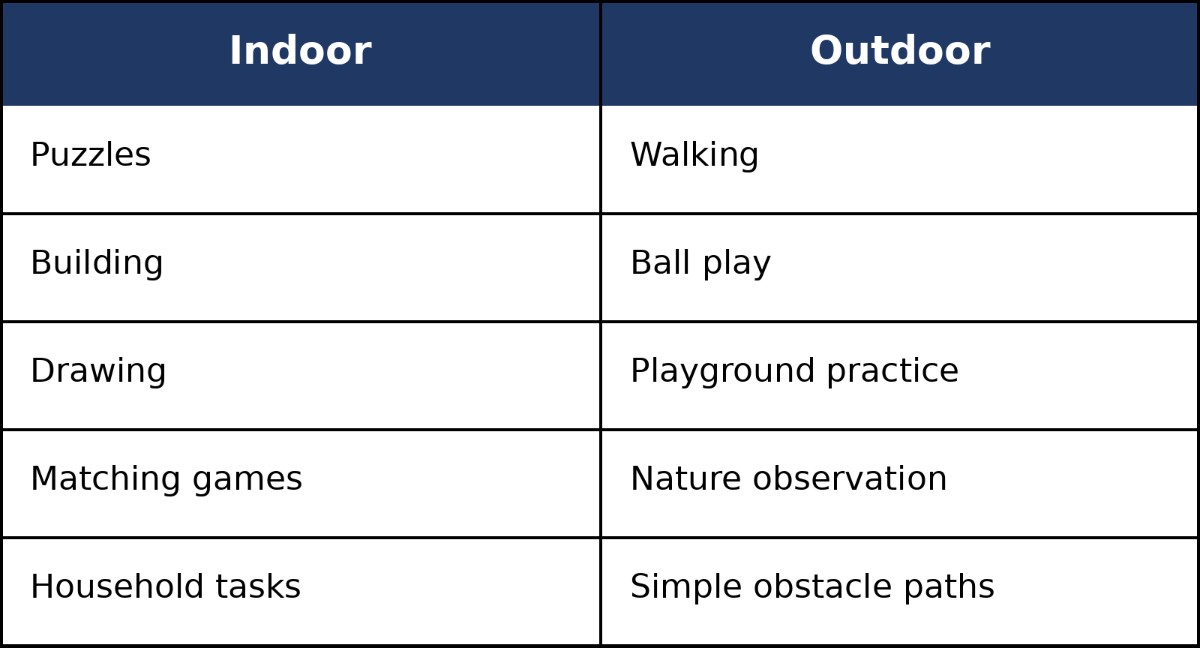
Outdoor activities may involve more noise, movement, unpredictable interactions, or safety considerations. Indoor activities may offer more predictability and control.
Neither is automatically better.
Choose based on your child’s goal, preferences, abilities, and current tolerance.
How to Adapt an Activity Without Changing the Goal
If an activity is not working, you do not always need to abandon it.
Grade it; don’t abandon it.
If It Is Too Difficult
- Reduce steps
- Use larger materials
- Model first
- Add visual support
- Shorten the activity
- Reduce choices
If It Is Too Easy
- Add another step
- Increase independence
- Add a choice
- Increase distance
- Introduce a small variation
If It Is Too Socially Demanding
- Start one-to-one
- Practice with someone familiar
- Reduce the group size
- Use predictable turn-taking
If It Is Too Sensory-Heavy
- Reduce noise
- Remove unnecessary textures
- Adjust the environment
- Shorten the activity
- Allow breaks
Change the demand—not your child’s worth or your expectations for meaningful participation.
Safety: When an Activity Needs More Planning
Activities should always be appropriate for your child’s age, abilities, and safety needs.
Consider:
- Choking hazards
- Small objects
- Water
- Climbing
- Running or elopement
- Heat and outdoor conditions
- Food allergies
- Equipment
- Required supervision
Do not assume an activity is safe simply because it appears on an “autism activities” list.
Use age-appropriate materials and provide supervision based on your child’s individual needs.
If your child has significant sensory, motor, feeding, communication, or safety concerns, consult an appropriate professional before introducing a challenging activity.
When Should You Involve an OT, SLP, or Other Therapist?
Sometimes an activity is difficult because the child needs more individualized support.
Consider OT When:
- Self-care is difficult
- Fine motor skills interfere with daily activities
- Sensory differences affect participation
- Motor planning is challenging
- School tasks are difficult
Consider an SLP When:
- Communication is difficult
- Your child needs AAC support
- Understanding language is challenging
- Social communication is a concern
Speech-language pathologists can support communication using speech, AAC, and other individualized approaches.
Consider Behavioral Support or ABA When:
- Specific behaviors interfere with learning
- Safety is a concern
- Communication or participation is being affected
- Your family needs individualized strategies based on assessment
The goal is not to collect as many therapies or activities as possible.
The goal is to identify the functional skill your child needs and determine how to support it effectively.
The Bottom Line: Don’t Choose an “Autism Activity”—Choose the Right Activity
There is no single activity that works for every autistic child.
A better approach is:
Goal → Sensory Load → Social Demand → Adaptation → Observation
Ask:
What do I want my child to practice?
Then consider:
What level of sensory input can they comfortably manage?
Then ask:
How much social interaction can they participate in successfully right now?
Finally, customize the task according to your child and see how they react.
The most helpful activity is one that provides your child with the right opportunity to communicate, move, participate, learn, regulate, or develop independence without any additional demands.
At Success On The Spectrum, activities incorporate structured, play-based environments designed around the children’s unique and individual learning needs. Science centers feature sensory rooms, playrooms, social rooms, simulated classrooms, and art rooms that allow them to practice skills in various ways.
The larger goal is to provide for skill generalization, which means teaching children how to use what you teach them somewhere other than a therapy room and in the environments they live, learn, play, and participate.
Find the Right Support for Your Child
If you are unsure which activities match your child’s communication, sensory, motor, or social needs, an individualized evaluation can help identify meaningful functional goals.
Explore Pediatric OT at Success On The Spectrum
SOS provides occupational therapy alongside ABA, speech therapy, and social skills services, depending on the child’s needs and services available at the local center.
FAQs
There is no time limit for all. Begin with a duration of time your child is ready to be a part of it and adjust based totally on their attention, regulation, interest, and the cause for the activity. A short victory can be more useful than forcing a child to continue after it has clear symptoms of overload.
Look for signs your child is either unable to actually engage meaningfully, seems more frustrated than usual, or needs extra support you simply cannot offer. Break it down and make it easier.
Yes. Activities that tap into your child's interests are more motivating and meaningful. Serving the developmental goal while having your child access a favorite toy, topic, character, or movement as a way to start.
Absolutely. Tasks such as putting toys away, sorting laundry, preparing simple food, or packing a backpack can provide opportunities to practice communication, motor skills, sequencing, following routines, and independence.
Consistency is usually better than completing long bouts of activity at once. Identify ways to practice important skills naturally during the day. An appropriate practice strategy for your child might be identified with the assistance of a therapist, depending on your child's individual objectives.

The Success On The Spectrum Editorial Team shares guidance and resources for families on autism, ABA therapy, speech therapy, and occupational therapy from Success On The Spectrum.